Showing posts with label China. Show all posts

Wednesday, June 24, 2015

Towards a new EU trade policy

The European Commission organised an "EU trade policy day" on 23 June to talk about the future of EU trade policy with business representatives, NGOs and think tanks. With the input from the conference, the Commission will now work out a new EU trade policy that it wants to present in autumn.

The EU might be a rather toothless tiger in defence policy, but its trade policy is an area from which it gets power in the world and legitimacy at home. If cleverly done, trade policy increases people's income and creates good jobs in the EU and abroad. If done poorly, the same policy can lead to widespread labour rights abuses, environmental degradation and destruction of companies. Therefore, the review of the Commission deserves to be looked at in detail.

Predictably, participants at the conference heard that most economic growth no longer takes place in the EU. Good trade policy must give EU companies safe access to the growth engines in the world like China or India. As new middle classes develop in the world, the EU should get ready to supply these middle classes before others will do it. That's what some people say.

But at the same time, it became clear that trade policy is no longer just about market access and reducing tariffs. Today's trade policy must also have good answers on labour rights, environmental protection, intellectual property, regulatory cooperation between trade partners, democratic participation and distribution of wealth. Today's  citizens want to know how their products or services have been produced. Does the low price stem from competitive business structures or low environmental and labour standards? The desire for information has led to a proliferation of private standards for fair trade, sustainable fishing or sustainable forestry. At the conference, some Members of the European Parliament then made it clear that the Parliament also wants to see a much stronger focus on fair trade in the upcoming "new generation" trade agreements (EU-Canada, TTIP, Trade in Services, EU-Japan, EU-Mexico, etc.). 

That is interesting: If this is really supposed to work, it means future trade agreements must have good structures to guarantee their monitoring and enforcement. Where one trade partner does not meet labour or environmental standards, the other trade partner may be allowed to retaliate. This also means that the "new generation" trade agreements could turn into a struggle of values, in particular if negotiations with China or India should come off the ground. Past efforts to bring them within a "Western" trade value system have not always worked so well. Will the EU be strong enough to assert its values against the lure of accessing these big markets?

The Commission will now draft its new trade strategy and share it with the general public in autumn. It will be interesting to see where the Commission puts its priorities. Then we will see if the EU is ready to negotiate and enforce more value-based trade partnerships, or whether classical market access logic will prevail.

Monday, May 25, 2015

Naomi Klein's new book: Change energy policies now or the planet boils over!

I’ve just finished reading a powerful and sometimes quite personal book called “This changes everything” by investigative journalist Naomi Klein. 

The book has a clear and simple message: Climate change cannot be fought through market mechanisms. Environmental policy is in direct competition with energy and industry policy; if we want to keep our planet from boiling over, environmental policy needs to go first. 

Klein shows that all attempts by governments to incentivise good behaviour by the industry through carrots and sticks are failing. As long as pollution is economically viable, emissions increase further. The half-hearted policies by our governments, if they remain the same, will heat our planet by much more than 2°C. Klein says that our governments wasted precious years doing nothing and must now immediately pass courageous legislation to drive down absolute emissions. Market solutions are no longer sufficient if climate change is to be stopped.


Below, I have collected some of the main arguments of the book. The Canadian journalist is also working on a documentary to be released in autumn 2015 (see preview embedded at the bottom of this post). 

  • The total coal, gas and oil reserves already indexed for exploitation by companies today equal about 2,795 Gigatons of CO2 emissions. However, studies today can say quite exactly how much more CO2 can be burned until 2050 to keep global warming below 2°C: not more than 565 Gigatons, only one fifth of the total resources already on the books. If governments were serious about curbing climate change, extraction of these resources should be heavily restricted; investment in fossil fuel companies should as a consequence become uninteresting. However, in March 2014 ExxonMobil informed its investors that current climate policies makes them “confident that none of [their] hydrocarbon reserves are now or will become ‘stranded’” (i.e. unusable). 
  • Fossil fuel companies hate renewable energy because it is a decentralised, locally- and people-owned form of energy. Meanwhile, fossil fuels rely on a centralised resource-extraction system that allows a few companies to make millions of dollars in profits. 
  • Fossil fuel companies and their employees follow a locust-principle: exploit and move on. None of the employees in the oil sector want to grow old in the places where they work. All want to get filthy-rich and take early retirement in a clean place far away. Meanwhile, locals in the regions under threat do not want to see their homes destroyed because of short-term profiteering. They want solutions which will preserve the local environment and lifestyle. 
  • 97% of the world’s climate scientists including the World Bank and the International Energy Association agree that climate change is man-made and that it will have unprecedented and dangerous consequences for the next generations. If no far-reaching changes are made, the scientists agree, we are headed for disaster. 
  • Right-wing politicians and businessmen in the US try to frame climate change as a hoax that the left employs to argue for more regulatory power of the state, less free markets and more redistribution of wealth. The right wingers perfectly understand the “dangerous” implications of strong carbon legislation. That’s why they spend millions of dollars to discredit the science and to kill climate legislation plans before they can get dangerous. 
  •  Some businesspeople and scientists think that human activity doesn’t need to change. Everything can be solved by shooting chemicals into the sky that will block sunlight. However, it is proven that using them will cause serious draughts and food crises in some parts of the world. And using them instead of reducing carbon will lock us into using them forever. 
  • It is not enough to encourage renewable energy – at the same time, fossil energy has to discouraged with increasing severity. Since this was not done in Germany, coal in that country has become a big competitor for renewable energy. To discourage fossil fuels, governments can for example introduce higher fossil fuel taxes that can be used to subsidies renewable energies. 
  • Bridge technologies only work if they do not become competitors to renewable energy. By exploiting bridge technologies like shale gas and tar sands, energy companies continue to make billions from fossil fuels without any restrictions. 
  • Much of the necessary climate saving depends on countries like China and India. However, the West carries a massive historical climate debt for 140 years of pollution. Even today, the West continues to outsource its pollution to the developing world. As a result of both, Western states must provide much of the financial resources to save the climate. 
  • Indigenous people in several North and Latin American countries are becoming pivotal actors in the fight against carbon extraction because they can lay ancient claims to the land in which oil and gas are buried. 
  • In many parts of the world, more and more determined “Blockadia” protests have sprung up. In these protests, citizens of all generations defend their regions against the profit-and-destroy mentality of the fossil fuel companies. Many governments including Canada’s, Greece’s, France’s and Nigeria’s are bitterly opposed to the protests and try to protect the extractionists. But it looks more and more that they are losing the fight against the citizen protests. 
The book makes it clear beyond any doubt that governments need to act now and impose binding limits on carbon extraction. No more market solutions, carbon-trading schemes and pollution offsets. The shift to renewable energy needs to be financed by taxing fossil fuel companies (and their customers). Obviously, this will redistribute a lot of cost to all of us energy consumers. 

Klein makes no secret about the challenges. No politician wants to destroy the jobs that rely indirectly on oil and industrial production by skyrocketing the oil price. Klein answers half of the question by pointing to the potential of new green jobs. But for the rest, she is clearly putting the reader in front of the choice: Either our politicians start today to eliminate fossil fuels, at the cost of job losses and re-education, or we will have unprecedented devastation and life insecurity for the next generations. We need to choose what we want.

Sunday, January 11, 2015

Freedom to criticize? Yes, but let's not forget that others can criticize us too

After the attack on Charlie Hebdo and the “I am Charlie” manifestations, somebody shared an interesting video on Youtube. The video was made by the ARAM Production house and explains that freedom of speech and Islam both contribute to a peaceful world – as long as they are not abused. 


Video by ARAM Production - English with Chinese subtitles 

While condemning any attacks in the name of Islam, the video also says that freedom of speech is not a blank check. It is important to remind this fact given all the people waving “I am Charlie” posters today. Freedom of speech also carries a responsibility. 

In this context, it is quite interesting to take a look at the discussions in China about the Charlie Hebdo attack. Some Chinese commentators take offense when Europeans and Americans declare our Western concept of freedom of speech as a universal value (see tweet below for example. In their view, it shows a degree of Western arrogance that the Chinese have long despised. Put bluntly, in our self-centered look at the world we fail to notice that there are other philosophies in this world that deserve to be listened to. And we should not exclude by default that other philosophies may offer things to this world that are superior to our own thinking. 


 In a more general manner, these Chinese commentators take offense that the debate in Europe is so disproportionately focused on bad things that happen to Europe because of influences from outside. What the Chinese would like us to do is take a more critical look at the negative influence that we and our so-called universal values have exported from European soil to the rest of the world. The Chinese have not forgotten the atrocities that we have committed in China and in the world in the last 200 years. And when we remember that these atrocities have given us wealth and development while locking the rest of the world into underdevelopment, we can never stop apologizing. The negative side of our Western influence on the world has so far been excluded from the European debate - and it should not be so. 
You could say that the Chinese are free to criticize us in as many articles as they like, the same as we criticize human rights and environmental mismanagement in China. But that would be to judge by Western values and mistake the Chinese philosophy. Yes, they did resort to criticism once by calling the UK “merely a country of old Europe with a few decent football teams” and it spurred a lot of offended talk in the British press. But in general, open criticism is not common to China. In return, if we praise our philosophy for its freedom to criticize, Chinese commentators expect us to also apply that criticism to ourselves. 

Bottom line: While we should uphold our freedom to criticise others, we should never forget that others also hold criticism against us. If we are taking freedom of speech seriously, that criticism maybe deserves a bit more attention in our media in the future.

Thursday, February 16, 2012

EU-China summit: Advance on Market Economy Status, retreat on Economic Partnership

At the EU-China summit in Tianjin, José Manuel Barroso, Herman van Rompuy and Chinese Premier Wen Jiabao agreed
that a rich in substance EU-China investment agreement would promote and facilitate investment in both directions. Negotiations towards this agreement would include all issues of interest to either side, without prejudice to the final outcome. [Both sides] agreed to work towards the start of the negotiation as soon as possible.
One the one hand, this is an interesting development. In the past, bilateral investment agreements have allowed European enterprises additional security in their overseas investments, given that they could directly seek arbitration with an international tribunal.

One the other hand, opening new investment negotiations suggests that the 2007 Partnership and Cooperation Agreement (PCA) talks are all but dead. At the time, the EU wanted to update the 1985 agreement that governs Sino-European economic relations, and adapt the partnership to the changed trade patterns of the 21st century (increased trade in services, increased volume of foreign direct investment, questions of intellectual property, China's entry into the WTO in 2001 etc.). The 2010 EU-China summit still referred to the PCA, but this year it was not mentioned a single time. Are economic relations between the EU and China running smoothly if a comprehensive economic agreement is silently scrapped and replaced with the promise of a potential investment agreement? I don't think so. 

Another import point at the summit was Market Economy Status (MES) for China. Despite China's WTO membership since 2001 (analysis: here), the EU has long withheld MES for China and used it as a bargaining chip. Now, it appears that Van Rompuy and Barroso are ready to scrap their opposition if China steps up its help in the Eurozone crisis in return. Granting MES to China would inter alia strengthen Chinese enterprises in anti-dumping cases. The ALDE group is particularly unhappy to see the EU's bargaining chip vanish, but it would soon disappear anyway, given that under China's WTO accession agreement, the EU agreed to grant MES automatically in 2016 (even though this is contested).

Overall, I do not have the impression that this summit was a great advance in EU-China relations. But then, good relations across different cultures are not created overnight. Instead, many small initiatives such as dialogues in climate change, energy, urbanization etc. continue to bring the two partners closer together. In the long run, I would hope that the EU and China, two of the biggest trading blocks in the world, can use the summits to give their voice to global trade and global sustainable development. But in the short run, I believe that bilateral cooperation will continue to take place on the micro-level.

Tuesday, January 3, 2012

A cultural war between China and the West?

The Chinese word for coffee - 咖啡, pronounced kafei - is a good example for the way in which Western culture has slowly crept into Chinese society. While the idea of drinking tea ("cha") has developed through centuries of Chinese history, coffee came from outside the Middle Kingdom. In phonetic terms, it has always remained on the outskirts of Chinese culture.

But when you walk through any bigger city in Eastern China, you will see Western coffee chains and fast food restaurants invite young Chinese into what is essentially a space of Western culture. With English being the international lingua franca, many Chinese people working in the export industry come into contact with Western values, send their children abroad for college and start celebrating Christmas (albeit as a largely secular holiday). Consumerism, Western entertainment and Western dating mentality have long reached Eastern China. Without doubt, they are a powerful force tugging at the foundation of a family-based society with a high degree of discipline and sacrifice.

When Chinese president Hu Jintao now speaks of a Western desire to divide Chinese society through ideology and culture (see here and here), one could of course respond with a shrug. Western influence comes to China as a result of market exchange in a globalizing economy. One could say that China pays the price for its participation in the WTO and its export-led development with cultural influx from its trade partners (while truly Chinese products have simply not incited Western demand yet).

But then, the story is more complex than that. Globalization has a significant influence on the structure of the Chinese economy, an economy that has for some time devoted all its resources to the demands of the rest of the world while neglecting domestic demand. Globalization has led to enormous migratory flows from the Western plains into the Eastern metropoles which are connected to the global markets. To put it a little plain, China has in some regards neglected its own culture in the interest of export-led economic growth. 

It therefore appears legitimate to raise the question how a country can brace itself against cultural influence from other countries. France, for example, has established a law that requires its radios to play 40% French music titles. In my view, Hu Jintao is correct to worry about the erosion of Chinese culture through Western influence. But it does not appear very helpful to speak about "international hostile forces [that] are stepping up the implementation of China's Westernization" (Google Translated). A cultural war between China and the West would really not be a smart thing, but then I don't really see it happen either.

As a final remark, the concept "the West" which is often used in China (closely associated to the idea of a Westerner, or laowai), is by no means culturally homogeneous. The US and Europe show immense cultural differences, in the way in which they consume information, in the way in which they view leadership and in way in which they view the ideal state, to name but a few aspects. And to return to kafei mentioned above: While coffee might be considered a Western product in the Middle Kingdom, its production is crucially important to guarantee the livelihood of many smallholder farmers - in Africa and Latin America.

I have focused on the economic aspect of Westernization; maybe my Chinese friends would like to comment on the cultural aspect of Western influence?

Sunday, December 11, 2011

Youth urge leaders at Durban conference: GET IT DONE!

As the Durban climate conference is going into its last negotiations (follow them at the tag #COP17 on Twitter or via Google News), young people have been given the floor to speak on behalf of global youths, representing half of the world's population.

Global Youth's message to Durban is perfectly clear: Failing in climate negotiations is the "most stark betrayal" that a generation can commit against following generations. And its message is perfectly simple: GET IT DONE!

Wednesday, December 7, 2011

Durban summit: Is China becoming a climate leader?

Three more days of climate negotiations in Durban and the EU's hopes for a binding agreement are vanishing into the distance. Climate commissioner Connie Hedegaard already told the European Parliament in November that she did not insist on a binding agreement but was prepared to make concessions, if other countries agreed to a binding commitment from 2020 and a clear roadmap until then.

After no ratification of Kyoto and no progress in Copenhagen and Cancún, I am by now downright resentful of the United States that shot down the Green Climate Fund upon arrival in Durban and that now prefers to nag China before committing itself to any binding accord. I have laid out before my view that emission reduction cannot wait and that developed countries should lower their emissions irrespective of what developing countries do.

Now, the US has waited for so long that it seems China might not only outgrow its economy but also become a leader in emission reductions. On Monday, China stunned the world by announcing that it supported a binding agreement by 2020 (albeit in return for five conditions such as common but differentiated responsibilities and a continuation of developed country subsidies for developing countries).

The Chinese volte-face leaves the US and India in a cold shower, and it makes the US and Canada as developed economies look particularly isolated. As it currently stands, the US refuses a binding agreement, at this point as well as for the year 2020. It pledges to reduce emissions by 17% until 2020 given 2005 levels while China says it "achieved a 20 percent reduction in carbon emissions between 2005 and 2010 per unit of gross domestic product and planned to cut another 17 percent by 2015" (given that GDP is still growing at around 8%/year, absolute figures continue to be on the rise).

Even though Chinese emissions are still rising in the short term, signs are multiplying that citizens are becoming increasingly unwilling to put up with air and water pollution. Millions of Chinese citizens protested online yesterday after several days of severe pollution in Beijing that caused the cancellation of hundreds of flights across China. The government heavily subsidizes the installation of solar panels on rooftops in parts of the country and China recently became the world's biggest investor in renewable energy.

These developments indicate that something is changing in China. With capacity-building and technology from the EU, China is moving onto the path of sustainable environmental development. It might be on the way to becoming a climate leader within in the next decade. The US, meanwhile, continues to pretend that life will always go on as it has before. It thereby not only endangers its own citizens but also citizens of the rest of the world.

Wednesday, April 27, 2011

Work, sweat, pay - Internships in Europe

The European Youth Forum has produced an interesting short film on internships in Europe.


Internships are not a way to save money but a way to build up future leadership. If you're in favor of paid internships in the EU, join the European Youth Forum in their fight. If you have done an internship yourself before, please share your insights by filling out this survey.

I may add that young Chinese are facing similar problems as young Europeans. An interesting issue to raise during the EU-China Year of Youth.

Sunday, March 20, 2011

Ambitious Five-Year Plan stops growth obsession

China’s 12th Five-Year Plan has received a lot of positive feedback from commentators in China and in the West. One of its main objectives is to reduce growth rates and to create more income equality. This is definitely needed, as growth remains limited to export-oriented business, inflation eats away most of people’s savings and high personal income tax does the rest.

Now the government vowed to wage a war on inflation, which is officially at 4.9% but probably much higher. One of the core instruments to reduce the income gap is a government investment program set to build 10 million affordable homes this year and 36 million units over the period between 2011 and 2015. This and other measures, the government hopes, will allow citizens to keep more of their salary in their pocket. In my view, it is a good idea because next to bringing social peace, it empowers the citizens and allows for more entrepreneurial ideas in the economy (China being a country in which the entrepreneurial spirit is quite well-developed despite its education system). Higher income also provides citizens with more political power in terms of what you may call “voting with your wallet”. In addition, it may well increase the legitimacy of the government, in which people are said to have little trust.

With regard to the environment, the Chinese objectives are remarkably ambitious. Renewable energies will be raised to 11.4% of China's energy consumption by 2015 and 15% by 2020, energy intensity is to be cut by 16% and carbon intensity by 17%. Officially, EU Climate Commissioner Hedegaard is highly delighted about the good news from China. In reality, the EU has to be very careful that China doesn’t overtake it in environmental policy. While the EU is talking about a smart energy grid, China is already implementing it.

However, problems are still apparent. Five-Year Plans passed by the national parliament (NPC) have generally been quite far-sighted; problems appear when it comes to implementing these policies in the provinces, and they concern environmental measures in particular. Many provinces do everything they can to enhance economic growth at the detriment of the environment. For the coming 2011-15 period, the government has lowered overall growth to 7% but 25 provincial regions out of 31 in the Chinese mainland set double digit growth rates. What the focus on economic growth can mean in practice has been highlighted by the film "The Warrior of Qiugang", that tells the story of a villager's fight against a polluting company next door (watch it here). Fearful of losing an investor, the authorities long refused to act in favor of the population. We can only hope that implementation will become better as the standard of living rises and corruption in public administration declines.

But overall it looks as though China wanted to move away from growth and GDP as indicators of progress and turn towards social, environmental and technological aspects. It apparently elaborates a new set of benchmarks including a kind of happiness index. Much remains to be done, as sources indicate that up to 94% feel unhappy given the unequal distribution of income. But if the objectives of the Five-Year Plan can be implemented on a regional and local level all over China, the country is on the best way to become a fully developed country.


To get a better picture of the Chinese economy, you may want to read this excellent report by HSBC.
Update 20/04/2011: Steward Fleming has a more pessimistic take on the Five-Year Plan, saying that "bureaucrats, operating in China's quasi-market system, are proving unequal to the task of slowing growth, curbing inflation, and managing the exchange rate of the yuan".

Thursday, February 24, 2011

China and EU start into Year of Youth


Today was the official launch of the EU-China Year of Youth in Beijing. 40 days after the European launch event in Brussels, 200 young people from China and the EU met in Beijing to kick off what will hopefully be a year of fruitful exchanges. They discussed potential EU-China cooperation projects, ranging from environmental protection to world heritage and intellectual property.

The cooperation is managed by the European Youth Forum (YFJ) on the European and the All-China Youth Federation (ACYF) on the Chinese side. Both have launched websites on the year of exchanges (China, EU) and an array of events and conferences is being planned in the EU and in China.

On the European side, the French are the most active organizers. They are trying to export the French language to China via a blogging competition (offline!) and a film festival for young Chinese. Second are the Germans with events on sport and social development.

But before you believe that the EU is relegated to being a spectator in culture, there are also some political EU-China Youth Events. Tomorrow marks the beginning of a a China photo exhibition in the European capital (I will try to cover it), other events include the European Youth Week or an EU-China Youth Culture Week. And also in China, some interesting things are taking place, such as the Shenzhen Universiade in August (college olympics).

Who knows, maybe we can even increase links between European and Chinese bloggers. China has a growing blogosphere (see English coverage here, here, here, here and here) and more conversation can certainly reduce a lot of cultural prejudices.


Launch video of the EU-China Year of Youth 2011

Sunday, February 20, 2011

For a strong EU condemnation of the murder in Libya

During the Tiananmen Square massacre in China in early June 1989, the Chinese army charged into a group of 100,000 protesters gathered in the center of Beijing - between 400 and 3000 protesters were killed, according to different statistics. Others estimate that more than 3000 protesters lost their lives.
The European Community issued a statement on June 6th (not available) and strongly condemned the "brutal repression taking place in China" at the European Council meeting on 26./27. June 1989 in Madrid:
"The European Council requests the Chinese authorities to respect human rights and to take into account the hopes for freedom and democracy deeply felt by the population [...] In the present circumstances, the European Council thinks it necessary to adopt the following measures:
  • raising of the issue of human rights in China in the appropriate international fora; asking for the admittance of independent observers to attend the trials and to visit the prisons
  • interruption by the Member States of the Community of military cooperation and an embargo on trade in arms with China
  • suspension of bilateral ministerial and high level contacts
  • postponement by the Community and its Member States of new cooperation projects,
  • reduction of programs of cultural, scientific and technical cooperation to only those activities that might maintain a meaning in the present circumstances"
  • During the last few days, more than 100 protesters have died in Libya, maybe even more than 200. Allegedly, snipers fired into the crowd, intentionally killing individual demonstrators. A tank intentionally crushed two demonstrators to death in their car. Facebook and Twitter have been blocked, international reporters are forbidden to report from Libya. Onlookers fear the worst.

    For the European Union, Libya has an important role as a watchdog. Gaddafi makes sure that the number of migrants flowing into the EU remains low. Esther Saoub, German correspondent in Cairo, believes that the EU will remain silent for some time in view of the protests in Libya: "Should the courageous demonstrators, who have these days dared to raise their voice, hope for support from Europe, their hope is probably in vain. Of course, Muammar Al Gaddafi is not popular with anybody in Europe save his friend Silvio Berlusconi, but since when are door guards ever popular? Still, nobody would have the idea to organize entry into an elite disco through grassroots democracy. Why should the EU be the first to have this idea?" (My translation)

    Given the situation, the EU should be as courageous towards Libya as it has been towards China in 1989. So far, nothing has been issued by the High Representative yet, neither on the pages of the EEAS, nor via Twitter. There is nothing that excuses the intentional murder of citizens, and there is nothing that excuses a cowardly EU statement on this murder. After the events in Egypt and the sudden love of EU politicians for human rights once Mubarak had fallen, everything but a strong condemnation of the murder in Libya would be hypocrisy. And it would show how much less important human rights are to us today than they were in 1989. Be courageous, Cathy Ashton.


    Update (20/02/11, 6:25 p.m.): Cathy Ashton has just issued two statements. One on the elections in Uganda, one on women's shelters in Afghanistan...
    Update (21/02/11, 12:30 a.m.): The declaration on Libya is out. "Extremely concerned", "We condemn the repression against peaceful demonstrators", "immediately refrain from further use of violence", "human rights [...] must be respected and protected", "immediately cease the blocking of public access to the internet and mobile phone networks", "legitimate aspirations and demands of the people for reform" - it's about as courageous as the Tiananmen declaration. An international conference on North Africa is to follow. Will economic sanctions be employed?
    Update (21/02/11, 9.30 a.m.): Also read reactions to Ashton's declaration here and here.
    Update (22/02/11, 8.34 p.m.): EU suspends negotiations on EU-Libya Framework Agreement. 

    Wednesday, February 9, 2011

    Jon Huntsman - US Ambassador in China to run against Obama?

    He's fluent in Mandarin, one of his adopted daughters was born in China and he communicates across cultural faultlines with elegance. After Barack Obama built a bridge between Caucasian Americans and African Americans, Jon Huntsman may build bridges between America and China. The US Ambassador to China handed in his resignation at the beginning of February - everybody expects the former Republican governor of Utah to take up the fight against Barack Obama in 2012.

    Huntsman is described by commentators as an inspiring, charismatic and intelligent person, leaving interlocutors "slightly glassy-eyed at the memory of their encounter". In comparing Huntsman to charismatic Bill Clinton, a British businessman says that “Clinton ... was just addicted to people, like a vampire he consumed them for his own benefit. I’d put Huntsman on a higher plane than that ... it’s Huntsman’s ability to make you feel like he’s always slightly off-script, a little bit close to the edge: a joke here, a side reference there, that makes you feel he’s incapable of being evasive and not phased by anything.” The US ambassador is known for thinking outside the box and would sometimes arrive at meetings with the Chinese Foreign Ministry on his bicycle.

    Of course, Huntsman's progressive and unconventional thinking makes him a difficult choice for the Republican Party. Orville Schell, Director of the Asia Society’s Center on U.S.-China Relations says that "given the acid political environment in Washington and the emphatically anti-intellectual attitude of all too many Republicans, one is left to wonder how long a man of Huntsman’s intelligence and international experience will be able to [remain an untarnished and energized candidate]". Besides, 17 other Republican politicians are mentioned as potential candidates for the presidential bid as well.

    For Europe, one of the most important questions is how far Huntsman could change the Republican Party. In a very interesting post, American author James McGregor estimates that Huntsman will have to "McCainize", to move far to the right to win the Republican bid. Where will it take him? You may remember that Republicans and Democrats alike based a considerable part of their last election campaign on China bashing. Will the Republicans now accept a mind as open as Jon Huntsman? And are they going to accept a candidate who worked for the Obama administration?

    I guess before Huntsman can close any cultural gaps to China, he has to close a pretty big gap within his own party.

    Monday, January 24, 2011

    Dambisa Moyo and the decline of the West

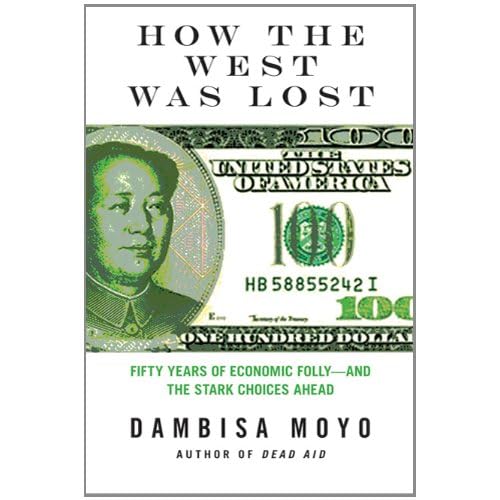
    After her bestseller "Dead Aid", Zambian author Dambisa Moyo has presented her second book, "How the West was Lost: Fifty Years of Economic Folly--and the Stark Choices Ahead".
    While "Dead Aid" was entirely focused on development in Africa, Moyo now turns to the industrialized West and diagnoses it with 50 years of paralysis.
    Working along the terms capital, labor and productivity, Moyo says that the West and in particular the US (but also the UK) have failed in all three regards.
    • With regard to capital, the US went deeply into debt by borrowing from China and investing into housing.
    • As far as labor is concerned, Moyo holds that Western pensions, health care and education are seriously underfunded, and disregarded in the democratic four-year cycles of most Western countries.
    • Productivity gains in the West, finally, have stayed far below those in China. Western countries do not try to use education to produce higher-quality products and services, but fail to reform their systems, meaning that they are headed to compete with China on the same playing field: labor cost.
    Although not saying that democracy is harmful, Moyo points out that four-year election cycles reward Western politicians for short-term thinking. To get out of decline, she proposes to either reform political systems in favor of a more long-term view, or to build strong incentives that encourage innovation and education. Or both. Without innovation, she says, countries will engage in a struggle for a shrinking amount of resources which is necessarily a zero-sum game and will produce bitter struggles.

    If you want to listen to the full speech that Moyo recently gave at the LSE, you can do so here:


    Picture Source: Amazon

    Saturday, January 22, 2011

    Aggressive China? Aggressive America!

    The whole western world went abuzz when China recently tested its new stealth fighter jet (more info here). In particular, Americans were put off because the test flight took place at the same time as Defense Minster Robert Gates met with Hu Jintao. A provocation? A demonstration of Chinese power?

    In following, military expenditure in the world:


    Source: www.globalissues.org


    Seeing that the US military is far superior to the Chinese military, lets look at US military deployment in the world:


    Countries with a US military presence in 2010
    More than 1,000 US personnel
    More than 100 US personnel
    Use of military facilities

    (Source: Wikipedia)

    In China's east, South Korea hosts 28,500 military troops (2007 figure) and 38 military installations, while Japan has 32,385 American soldiers or military staff on its soil (2010 figure). In and around Afghanistan, the US has 105,900 troops (2010 figure) that come into Asia through a US travel base in Kyrgistan, China's neighbor in the west. During South Korea's last military exercise, the US deployed an aircraft carrier into the Yellow Sea that separates South Korea from China.

    Somehow understandable that China feels a little threatened, isn't it? Everything points to the idea that the US is seeking to contain China. What would happen if China dispatched an aircraft carrier to Cuba in return? I can already hear the US media panic.

    Recently, an article from a Peking University resurfaced and caused much discussion in the Chinese blogosphere: "If the United States Attacked China, I Would Surrender". The Chinese believe it is a real threat that the US will use military power to advance its own interests in China.

    In Japan, the presence of the US military is already contested. The troops have been involved in 200,000 mostly traffic-related accidents and acts of crime against Japanese in which 1,076 Japanese civilians died since 1952.

    Given an increasingly assertive China, the US Military Chief has vowed in early 2011 to put a special focus on Asia. How will China react?


    By the way: Chinese president Hu Jintao finished his three-day state visit to the United States successfully. Read more about it here and here.

    Sunday, January 9, 2011

    China and the "laowai"


    "You don't know anything about China!"


    I've heard that sentence quite a few times in China. One of the first words you will memorize as a foreigner in China is laowai, or foreigner. The word strikes a dividing line between you and the society in which you live. Being a foreigner, by definition you don't know China’s "unique national conditions". You don't know the exceptionalism that arises from a proud, 3000-year-old society, humiliated during the Opium Wars of the 19th century, invaded by foreign powers during the World Wars and mutilated by a ruler who is still praised as the country's national hero. And people will hold your ingnorance against you in the same way as this LSE (!) student does it from minute 44:00.

    The relationship between China and the laowai is a very strange matter. On the one hand, Chinese people are extremely interested in American movies, American clothes, Christmas, McDonald's and other parts of Western consumerism. When I walked through central Shanghai, people were staring at me in awe. School girls asked me for a photo. Public schools in China employ foreigners to teach English, from high school all the way down to kindergarten. Clearly, there is an interest to know more about "the West" and about those laowai.

    On the other hand, there is a deep inferiority complex toward those laowai. "Lao" itself means "old" and is normally used with a person in a more senior position. By definition, all laowai are filthy rich (which is true in a sense, considering the low value of the yuan). And filthy rich means that they're socially superior. A Chinese person will have to work a lot more than a Westerner to achieve the same social standard.

    Put together the fact that Western people in China are filthy rich and that they have no idea about Chinese exceptionalism (or even the language, as the language in many foreign enterprises is English), could there be a desire to strike back at the West? Pay back the humiliation once Chinese money and power really kick off? Harvard Professor Niall Ferguson heard an invisible "We are the masters now" from his interlocutors when he recently went to China. In the EU, Portugal, Greece and Spain are now financially dependent on China. Are we facing a danger of revenge?

    As laowai, we should probably spend some afternoons studying Chinese history - so that nobody can tell us "You don't know anything about China!" anymore.

    Update (23/02/2011): We could start here, here or here.

    Wednesday, January 5, 2011

    MountEUlympus back in action

    I've come home from China and will start blogging again. It's pretty exciting to come back just now, with the EU busy about the Hungarian Media Law, the Hungarian presidency, democracy in Italy and saving the Euro. Taken as a whole, 2010 has certainly been one of the EU's most challenging years since 1957.

    The new year is always the time for new plans and new beginnings, so I will try to do some new things as well. First of all I'm honored to join the bloggingportal.eu editors. Hope that I can do some good things as an editor. To that effect, you can also add me on Twitter now. Secondly, I will give a new focus to my blogging. Sure, I'm still writing about institutional affairs and current EU events. But I want to pursue a few topical issues as well.

    The most important one is China. We don't know anything about this new world power. And the way it is, we are headed into a clash of cultures between "the West" and China. In my blogging, I will take up issues that China talks about and take up EU-China questions, trying to avoid the conventional bias of our media. The question is, how can "the West" and China be reconciled? How can the faultlines be mended? Where does assimilation take place, in China or in "the West"? Obviously, talking about "the West" will not be limited to the EU but essentially incorporate the US as well...

    The second aspect is the global economy. This will be a learning-by-doing experience, as my knowledge about international trade flow and finance only stems from a bachelor's degree. Together with the global economy, I also want to explore questions of sustainable development in the world.

    The final aspect is event journalism. I will move into the Brussels bubble in a bit and try to cover some European Councils, press conferences and what else seems of interest to me and to you. Depending on the opportunities I get, I'm also going to play with my video camera and try to interview some of the people that keep the wheels spinning in Brussels.

    At any rate, this is an exciting time to recommence blogging. After the #EUCO tweet wall event, I expect that we'll have to negotiate how blogging and bloggers can be incorporated into EU policy-shaping in the future.

    Glad to start this new year together with you. I'm looking forward to a lot of fruitful interaction and debates.


    P.S. if you're too busy to check this website for updates, how about copying its RSS feed into your feed reader?

    Friday, August 27, 2010

    Taking a break

    After one and a half years, this blog is taking a break. A new personal project leads me to China where I will be far away from European affairs and politics in general.
    I will continue following European blogs where I can and hope to pick up writing again when I come back.

    It's been a great time and I've enjoyed blogging very much. Keep up the good work fellow bloggers, and show them that a Europe of the citizens is possible after all.


    Best wishes,
    André

    Saturday, September 26, 2009

    Chinese in Europe - a glimpse of the future

    Trying to familiarize myself with my new home in Milan, I took a stroll around the city and finally ended up in the Chinese district in the north of the city center. Ever since I read that Milan supposedly has the second biggest Chinatown in Europe, I've been very excited to get there and to see what was going on in there. The Financial Times journalist James Kynge believes that China is slowly taking over Italian production of fashion, starting with the manufacture of clothes in China, and ending with outsourcing the design of Italian fashion.

    When I got there, I could see that incredible Chinese activity firsthand. Chinese workers, putting huge boxes of clothes into fashion stores, waiting to sell them to the next customers. Chinese men biking across the main road with heavy boxes of clothes loaded onto their bike. Chinese housing agencies, selling and renting out buildings and apartments of the district. And everywhere you see small offices with the label "Import - Export". I couldn't help thinking that they there was an entire city district, working hard to import Chinese products into the European market, and working even harder to export European money back to China. Kynge holds that many Chinese workers came here illegally to work in small jobs and earn money for their families back in China, slowly shifting wealth from Europe to southern Asia. And I could see myself that those workers tirelessly unloading more boxes of clothes were very committed to their job, even on a Saturday evening at 5 p.m.

    I'll start surveying that Chinese district a little and try to find out more about it, try to find out why Chinese people came to Europe and how they harmonize with Italians in Milan. I have an inkling that this Chinatown gives a first impression of what the world may look like - maybe not in 20 years, but probably in 50 years time.

    I have to admit that I was also seduced by all the cheap stores at the end of my visit, and I went to do my share of shopping. By now, maybe my money will already be invested in import-export businesses in China, fashion production in Shenzhen or maybe in high school and university education for Chinese students.