Showing posts with label France. Show all posts

Sunday, January 11, 2015

Freedom to criticize? Yes, but let's not forget that others can criticize us too

After the attack on Charlie Hebdo and the “I am Charlie” manifestations, somebody shared an interesting video on Youtube. The video was made by the ARAM Production house and explains that freedom of speech and Islam both contribute to a peaceful world – as long as they are not abused. 


Video by ARAM Production - English with Chinese subtitles 

While condemning any attacks in the name of Islam, the video also says that freedom of speech is not a blank check. It is important to remind this fact given all the people waving “I am Charlie” posters today. Freedom of speech also carries a responsibility. 

In this context, it is quite interesting to take a look at the discussions in China about the Charlie Hebdo attack. Some Chinese commentators take offense when Europeans and Americans declare our Western concept of freedom of speech as a universal value (see tweet below for example. In their view, it shows a degree of Western arrogance that the Chinese have long despised. Put bluntly, in our self-centered look at the world we fail to notice that there are other philosophies in this world that deserve to be listened to. And we should not exclude by default that other philosophies may offer things to this world that are superior to our own thinking. 


 In a more general manner, these Chinese commentators take offense that the debate in Europe is so disproportionately focused on bad things that happen to Europe because of influences from outside. What the Chinese would like us to do is take a more critical look at the negative influence that we and our so-called universal values have exported from European soil to the rest of the world. The Chinese have not forgotten the atrocities that we have committed in China and in the world in the last 200 years. And when we remember that these atrocities have given us wealth and development while locking the rest of the world into underdevelopment, we can never stop apologizing. The negative side of our Western influence on the world has so far been excluded from the European debate - and it should not be so. 
You could say that the Chinese are free to criticize us in as many articles as they like, the same as we criticize human rights and environmental mismanagement in China. But that would be to judge by Western values and mistake the Chinese philosophy. Yes, they did resort to criticism once by calling the UK “merely a country of old Europe with a few decent football teams” and it spurred a lot of offended talk in the British press. But in general, open criticism is not common to China. In return, if we praise our philosophy for its freedom to criticize, Chinese commentators expect us to also apply that criticism to ourselves. 

Bottom line: While we should uphold our freedom to criticise others, we should never forget that others also hold criticism against us. If we are taking freedom of speech seriously, that criticism maybe deserves a bit more attention in our media in the future.

Thursday, October 17, 2013

MEPs ask for an end to Brussels-Strasbourg travelling circus

Members of the Constitutional Committee of the European Parliament on Monday took a first step to end the travelling circus of the Parliament between Brussels and Strasbourg.

In a report (see the draft report here) that was adopted by 20 to 4 votes, the committee urges to give the Parliament the say over its location, its calendar and the modalities of its meetings. 

"We want to have one seat, so that we can save money and carbon dioxide," commented the co-rapporteur of the resolution, British MEP Ashley Fox, in a press conference on Tuesday. At a time where European citizens are asked to make cuts, an estimated 200 million EUR is spent by taxpayers every year to fund the monthly travel of 766 MEPs, their assistants and Parliament staff from Brussels to Strasbourg and back. The MEPs of the Constitutional committee find this an unnecessary waste of money and carbon dioxide.

"This report is a small revolution, but it will be the beginning of a bigger revolution," the second co-rapporteur Gerald Häfner (Germany) added. "We want to take our own decision about where to have the Parliament's seat, but we are hostages of the European Council, the member states and their governments." The seat of the Parliament is written into the EU treaties, and a treaty change requires unanimity by all 28 EU member states. The French government has indicated many times that it will not agree to abolish the EP seat in Strasbourg.

Many people have tried to end the monthly travelling circus before, but always in vain. Fox and Häfner believe that this time will be different. "This is a new thing," said Häfner, "because the Parliament has never before asked for a treaty change that would allow it to decide itself where and when to hold its meetings." 

Fox and Häfner are certain that by now there is a majority in the European Parliament in favour of a single seat, a majority that runs through all the political groups. It appears that quite a few European governments are also in favour of putting an end to the travelling circus but they would not like to directly pronounce themselves in favour of either Strasbourg or Brussels. To bring the report through Parliament, the two rapporteurs have therefore decided not to mention either Brussels or Strasbourg. "We don't take a stance about where the single seat should be," said Fox. 

Nonetheless, there was a bit of opposition to the single seat report. When it was voted on Monday, a number of French MEPs not belonging to the Constitutional committee tried to highjack the decision. They had added 87 amendments to dilute the impact of the report (most of which were rejected) and attempted to cast votes in the committee even though they were not member of it. The committee had to pause several times until the final vote could take place.

The report will now be voted by the plenary on 11 November vote and Ashley Fox believes that only few MEPs will be brave enough to put down their name for a two-seat solution. If the report is adopted, the Parliament would wait until after the elections in May 2014 and then formally submit the report to Council. The Council would then be forced to debate the question of the single seat and take a vote on it.

The next European convention to review the EU treaties, probably in 2015, would then debate the Parliament's request to decide itself on its location, said Häfner. And an agreement would have to be found to compensate the country which would lose its European institutions, added Fox.

Tuesday, May 8, 2012

Is Martin Schulz emerging as a new leftist leader in Europe?

On the morning after François Hollande was elected president of France, Martin Schulz sat in his office at 7h50 and gave an interview to Deutschlandradio. Then his press team sat down to write an opinion peace for Project Syndicate. Not only François Hollande wants to move away from austerity, Schulz said. The European Commission under Barroso is also convinced that more growth cannot come about by austerity alone. And the European Parliament, with Schulz, an (albeit impartial) social democrat at the top, is also coming out in favor of less austerity.

As a German commentator observed on Sunday, the word "super election day" several years ago meant elections in two or three large German states. Today, it means elections in France, Greece and Serbia (and Schleswig-Holstein). In an integrated European economy, national policies can no longer be shaped in isolation; policy-making has to shift from the national to the European level to remain efficient. Mathew suggested that we have seen the emergence of a truly European debate on economic policy in the last few months - more austerity against more growth programs instead of more Europe against less Europe. I think he is right. And now that Hollande's rise to power shifts European policy-making from austerity to growth, the president of the European Parliament appears well-placed to broker and negotiate this transition within the European institutions. He could emerge as new leftist leader in European policy-making, if not in front of the cameras then at least in the hallways of the institutions.

The next European Council will have growth programs on its agenda. And Martin Schulz has been fighting for the inclusion of the EP president in the negotiations of the fiscal pact. It will be interesting to see how much he will use his position and his intra-party networks to help broker a growth program in Europe.

And then? National elections in Germany are next year and if the European mood, inspired by Hollande's election, turns toward growth programs, then the German elections might sweep the former social democrat finance minister Peer Steinbrück, an efficient pro-European, to power. Might be a very interesting constellation for social democrat governance in Europe: Hollande - Steinbrück - Schulz.

Friday, October 21, 2011

MountEUlympus at the EPP Summit

In the footsteps of Julien Frisch, Joe Litobarski and Andrew Burgess, your humble blogger will cover the summit of the European People's Party (EPP), held this Saturday evening in preparation for the European Council on Sunday (and Wednesday).

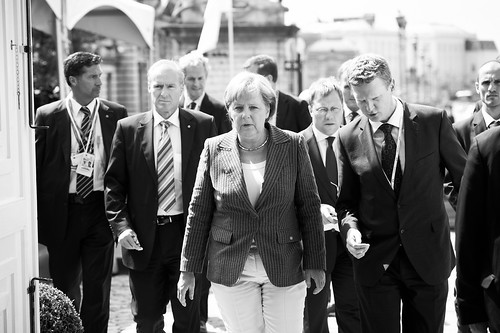
Angela Merkel at the EPP Summit in June 2011
Source: Flickr CC BY europeanpeoplesparty

The EPP currently brings together 17 of the 27 European heads of state or government, among others Angela Merkel, Nicolas Sarkozy, Donald Tusk and Silvio Berlusconi. Discussions at the summit will mainly center around the Eurocrisis, which already brought one EPP government down last week (Iveta Radicová's liberal-conservative coalition in Slovakia). Will EU leaders, Merkel and Sarkozy most of all, be able to come to a sustainable agreement? Will they be able to produce a consistent solution that appeases the markets and brings back politicians' credibility? These are the questions that this blog will address at the EPP summit.

I will be live-tweeting directly from the summit (follow my account @mounteulympus or the hashtags #epp and #euco) and provide you with a round-up in the aftermath of the summit on this blog. You can send me your questions, comments and remarks by comment function, via Twitter or through the contact form, and I will try to address them at the summit.

Monday, July 18, 2011

MEPs should have the democratic right to decide where they meet

For those who haven't had a chance to read it over at PlaceLux.EU, here is the open letter that MEPs have sent to the new French secretary of State, Jean Leonetti (taken from MEP Raül Romeva i Rueda's blog).

CM. Jean Leonetti
Secrétaire d'Etat aux affaires européennes
Ministère des Affaires étrangères et européennes
37, Quai d'Orsay
75351 Paris
France
                                                                                  Brussels, 14 July 2011
Dear Secretary of State,

MEPs should have the democratic right to decide where they meet


Please accept our congratulations on your appointment as France's new Minister for Europe. We wish you success.

There is now an Absolute Majority in the European Parliament in favour of a Single Seat. Following the vote on June 8 on the Multiannual Financial Framework, enough MEPs have now adjusted their record to achieve an absolute majority (373-285) on the paragraph pointing to "the significant savings that could be made if the European Parliament were to have a Single Seat". This Absolute Majority -as well as the 2012/2013 calendar vote in March- fundamentally shifts the debate.

As you know, the EU Treaty requires the European Parliament to hold 12 monthly plenary sessions in Strasbourg. As a result, we meet in Strasbourg 48 days every year. From next year, this will be 45 days, following our vote to hold the two October plenary sessions during the same week to save money, time and the environment. This democratic decision of the Parliament is being contested by France before the European Court of Justice in closed proceedings.

All of the Parliament's other activities take place in Brussels (with the exception of a part of the administration, which is based in Luxembourg). Brussels is where committee and political group meetings are held. It is where most of our staff are based. It is where the other two institutions that form the EU decision-making triangle (the Council and the Commission) are located. Over the last 50 years, Brussels has evolved into the EU's democratic capital. It is where companies, NGOs, national, regional and local governments, industry associations and trade unions all have their offices. It is where the EU press corps has its hub, including technical facilities.

When the European Parliament started meeting in Strasbourg over 50 years ago, it was a consultative assembly with part-time Members who were not directly elected, it was purely advisory and had no powers. Today, it is on a par with the Council of Ministers when it comes to making laws and its Members are full-time legislators, directly elected by the peoples of Europe. Yet unlike national parliaments, it cannot decide when and where it wishes to meet.

Recent votes in the European Parliament as well as several surveys have shown that a majority of MEPs believe the European Parliament should have a Single Seat, in Brussels. The Dutch and UK governments have publicly backed this view. More than 1,25 million European citizens have signed an online petition to this effect.

Over time a number of parliaments have moved to reflect political reality: the US Congress moved from Philadelphia to Washington; the French Parliament moved from Versailles to Paris; and more recently, the German Parliament moved from Bonn to Berlin. We believe that in a modern Europe, the European Parliament must be able to do the same. We call on the French government to stop the political and legal posturing on this issue, and to enter into a real debate.

All we ask is that MEPs should be able to exercise their democratic rights and decide when and where to meet. In return, we are ready to help identify alternatives for the city of Strasbourg, both in institutional and in economic terms.

For Strasbourg, a better and brighter future lies ahead. The European Parliament has now far outgrown it. It would be better to find an alternative that matches its facilities and can be a more grateful guest.

Yours sincerely,


(MEPs)

Sunday, January 30, 2011

Day of Franco-German friendship on January 22nd

There are three annual political holidays that I try not to miss. May 9th, the Day of Europe. July 14th, the French national holiday. Yes, I am German and comfortable with it, but October 3rd doesn't spark a lot of patriotic emotions with me (in contrast to the football worldcup which definitely does). July 14th with its fireworks around the Eiffel Tower is certainly a more memorable event. The third holiday is the day of Franco-German friendship on January 22nd.

I am reminded of the former two holidays by the media, but I always miss January 22nd. Was I not paying attention, or were the media not paying attention?
Well, I admit, I forgot it. However, what speaks in favor of me is that all self-proclaimed Franco-German blogs on the web including Vasistas, l'Europe en blogs, Le Blog Franco-Allemand, Le Franco-Allemand, Deuxzero, deutsch-franzosisch, Frankreich heute, Bernard de Montferrand, Scharlotte en France, Komische Petite française, Berlin & Co, Le Blogueur and the Franco-German couple blogging at Fenris et Fionan also forgot it.

Does the holiday have such a low importance that nobody cares to remember it? No! Praise goes to Das Frankreich-Blog - France Blog, which extensively covered the Franco-German Day. And on a political level, Germany and France celebrated as well. Secretaries of State Werner Hoyer and Laurent Wauqiez met in Paris on Tuesday, January 25 for a working lunch, followed by a visit to a French kindergarten and a debate at the French elite university Sciences Po. Foreign Ministers Guido Westerwelle and Michèle Alliot-Marie (sadly, Bernard Kouchner has eventually been shuffled out of the cabinet by Sarkozy) had already published a joint declaration on January 22nd. They affirm their commitment to the Franco-German Agenda 2020 and Germany declares its support to the French G20 presidency. In schools and public institutions in France and Germany, the Franco-German Day was celebrated as well.

Next year, I promise not to miss this holiday. And I hope to celebrate it in an adequate fashion as well.


By the way, if you are a young German or French professional, you can apply for a Franco-German future dialogue organized by DGAP and IFRI. However, the deadline for applications is today, Monday January 31st.
If you are interested in a one-year postgraduate
Franco-German Master of European Governance in Paris, Strasbourg, Potsdam and Berlin, you can still apply until May 15th.

Wednesday, May 26, 2010

France and Germany are again playing old power game in climate change

The refusal of France and Germany to back Climate Commissioner Connie Hedegaard's proposal of curbing emissions by 30% until 2020 stems from a backward logic and is detrimental to the EU's soft power. "The European Union is ready to adopt the 30 percent figure if other major economies make comparable undertakings," French industry minister Christian Estrosi is quoted by EUObserver after a joint press conference with German economy minister Rainer Brüderle.

Estrosi and Brüderle want to play the old power game that led to the failure of Copenhagen: "We don't budge if you don't budge." Yet, it was apparent already at Copenhagen and also after Copenhagen that China was really not impressed by the EU's power play, to put it politely. The EU lost its multilateral negotiation power in Copenhagen and playing power games now does not get it back. Those of you who are familiar with game theory will understand that after a look at the rudimentary game tree below:


It is clear from the game tree that China wins if it chooses not to regulate its emissions, regardless of what the rest of the world does. It is also clear that "(m)ost of China's policy initiatives that affect climate change have come about without any direct reference to international frameworks, but have been driven by domestic policy needs" (Freeman and Holslag). Meaning that power games are rather useless.

There is only one thing that China wants and doesn't have. Technology. European comparative advantage is in technology. And if Freeman and Holslag are right that "the EU considers the combat against climate change . . . as a source of soft power", policy-makers are well-advised to start leading by example. The North-Sea Grid and the Desertec Initiative (which btw also extends to China, the US and Australia), for example, have not been paralleled by comparable projects initiated in the States or China, and progress in these projects can lead to more soft power for the EU.

Leading by example means leading by successful implementation of ambitious programmes at home. An ambitious target of 30% emission reduction entails a lot of research into best practices, consumption habits, carbon capture and storage, market mechanisms in environmental protection and other fields. An ambitious target is therefore a significant factor contributing to development of technology and thereby soft power.

Let alone that refusing an additional 10 base point emission cut where it is technically possible is not a particular sign of respect toward the population. It is true that developing countries face a trade-off between economic development and environmental protection (i.e. one declines as the other grows), but developed countries with a high degree of technology are less subjected to this trade-off and can prioritize economic development AND environmental protection.

And it is not a sign of particularly intelligent government communication that Chancellor Merkel is currently wandering through the eco-city "Masdar City" learning all about intelligent sustainable development while her economy minister rejects a stronger engagement of the EU in favor of old power games.

All in all, this makes me feel like we are far away from using the resources we have, and far away from making sustainable development a source of soft power.

Tuesday, March 16, 2010

Christine Lagarde is right

It is surprising how harsh the reactions were from the German side when French finance minister Christine Lagarde told policy-makers in Berlin to step up domestic consumption. German enterpreneurs suggested other Member States "do their homework" and step up their own competitiveness so that they wouldn't need additional German investment. The government and Commissioner Günter Oettinger agreed that German products should remain cheap as not to compromise its export revenues.

But in my view, Christine Lagarde is absolutely right. As I have expressed here, Germany's so-called "competitiveness" is essentially a public bailout of the enterprises on the shoulders of the working population. Of course it is true that Germany has the strongest economy in Europe and contributes much to growth in other Member States. But that can be increased by shifting resources back from the businesses to the consumer: A legally imposed minimum wage as practiced almost everywhere in the EU would raise aggregate consumption - and note that people have proven on various occasions throughout the crisis that they did not save the money they had at their disposal - which then means
  • more consumption of domestic goods and services
  • more consumption of foreign (inter alia European) goods and services
  • more possibility to invest in enterprises at home and abroad, and thereby a greater involvement of the citizens into economic decision-making and a greater democracy in some enterprises
Yes, it also means that enterprises have less financial room for manoeuvre and investment. It means that some enterprises will relocate, to European states with a lower labor cost (beneficial for inter-EU trade) or to extra-European states (bad for the EU). But as the high-skilled services sector is taking ever-increasing importance and businesses have already come back from Asia in fear of technology theft, a large part of enterprises will not compromise the conditions that they find in the education level, social climate and infrastructure of central Europe.

Therefore, Christine Lagarde is absolutely right. For the last ten years, German entreprises, withholding pay rises of the employees despite inflation and higher product revenues, have benefitted from a society that does not take to the street except against nuclear power and right-extremists. They have benefitted from a disunited, individualized workforce that can be easily put under pressure. They have benefitted from state contributions if they employed a recipient of social security.

Let's not talk about repaying those ten years. But it is about time the employees/consumers obtained their rights for the benefit of the rest of Europe.


Update: Couldn't say it better than Robert von Heusinger in this article (translation: Google Languages/myself):

"Let's take the economic growth as the epitome of wealth and power of an economy. Here the matter is clear: France grew by an average of 1.5 percent in the last ten years, while Germany only grew by paltry 0.8 percent. Also in terms of employment as the epitome of participation and self-esteem of the people, the country across the Rhine performed better: while France's employment grew by 0.8 percent per year on average, in Germany it only climbed by 0.5 percent.

Where does this French success come from? From domestic demand, private consumption. It averaged 2.2 percent, four times as high as in Germany (0.5 percent). How did France achieve this - in spite of globalization? Through higher wages, that's the simple answer. The slightly more sophisticated one: it was achieved through an economic policy that recognizes interrelationships instead of blindly reducing national debt, shrinking the state sector, and relying merely on competitiveness."

Update 2: Christine Lagarde is completely wrong, on the other hand, if she suggests to finance consumer spending through tax cuts. That would take money away from state services like education and research and development that dearly need it. Consumer spending has to be financed through the real economy. The money has to be shifted from the enterprises to the citizens, not from the state to the citizens.

Saturday, February 6, 2010

Minutes from Newropeans/Grillo meeting in Paris

Newropeans is a supranational citizen organization that wants to make the European Union more democratic. Rather than on societal problems, Newropeans mainly focuses on the institutional reform of the European Union. At the European elections 2009, the organization stood for elections in Germany, France and the Netherlands. However, they could bridge neither the threshold in Germany and France nor win a seat in the Netherlands (no threshold). Since then, not much has been heard of them.

Beppe Grillo is an Italian comedian, blogger and millionaire (see my post about him here), who believes that the future of democratic representation lies in the internet. In Italy, he has become quite popular among young people.

Newropeans and Beppe Grillo met in Paris on Saturday. It was the first time since the elections that they really raised their voice. Here are my comments to their livestream (or fast-forward to my analysis at the bottom of this post).


-Start at 14.30

-First twenty minutes: Grillo is poking fun at the world, entertaining the people. Laughs everywhere. The talk is in Italian and French. Most people in the audience seem to understand both. The panel is talking to an elite.

-Now he's talking about the development of his blog. 25 minutes into the talk. Still nothing tangible.

-Livestream viewers remain at about 20. Pretty stable.

-They got me via their Facebook communications. "Beppe Grillo, Franck Biancheri, Marco Travaglio en conférence-débat: La démocratie en danger: Italie-Europe, les citoyens résistent". So far, the discussion hasn't really mentioned where the danger to European democracy lies in the first place. Nor presented any solutions.

-Finally it's getting more tangible. They're talking about broadband internet access for citizens in Italy. Wish he wouldn't always scream like that.

-Grillo talks about the lack of objectivity in Italian media, naming Corriere della Serra as an example. The web offers a second entry into debate which is not restricted by media agendas.

-Grillo stopped talking. Time for questions.

-A citizen reassures Grillo of the solidarity of young Italians. Italy had a big public discussion when a university professor advised young Italians to better leave the country.

-Grillo talks about the potential of online campaigning. The web allowed the Swedish pirate party to gain support. It allows people to connect across different countries and continents.

-I wish he wouldn't scream like that.

-What happened? Viewers sprung up to 440.

-Over to Franck Biancheri, Newropeans president. Led the party into the European elections 2009; they stood for elections in the Netherlands, France and Germany.

-Biancheri talks about the young generation. Flexible, international, able to adapt to changes. A generation that wants to use its rights as European citizens.

-No other continent besides Europe in which cultures interact in a comparable way. Young citizens profit enormously, says Biancheri.

-Biancheri: The power places in Europe are not Berlin or Paris any more, but Brussels and Frankfurt. They are unaccounted for and don't reflect the opinions of the 500 Million citizens of Europe.

-The importance is to create a structure that allows a democracy from below, says Biancheri.

-Those who want to change something see the space for political action diminish in the nation-states and competences move to Brussels. The political debate has to follow to Brussels, according to the Newropeans president.

-Different electoral structures in the nation-states. Germany: 4000 signatures to put up a list for elections. Netherlands: Only very few. Italy: A lot of signatures. The electors in Italy and Germany don't seem to be equal, says Biancheri and wants to create a single electoral procedure in Europe.


-Grillo is back on. Criticizes the fact that there is no common European vision in Brussels.

-Grillo puts on a red hat resembling the hat of the Ku Klux Klan, and disappears from stage.


-Over to Marco Travaglio, Italian journalist.

-Firefox keeps on shutting down.

-Viewers are up at 600.

-Travaglio recommends an Italian blog, opinione.it.


-Back to Biancheri. He says that 80% of all French media are financed by the state.

-"Nothing is going on in the world [seen through the eyes of the French media]. Except an old lady run over in Southern France, a little dog somewhere in France..."

-Recruitment process in French media: "You take young people that aren't really up to the scratch. Fooling someone who doesn't understand is easy. Fooling someone who knows the subject is already more difficult."

-Journalist selection has to follow more specific criteria, he says.

-European journalism: A much bigger difficulty, since the policy area is more difficult to understand.

-Independent European journalists are necessary. The European institutions spend a lot of money to obtain only positive coverage about Brussels politics, says Biancheri.

-The "Erasmus generation" will need to move the EU out of the impasse. "The only language is translation ... We have a lot of young people who speak the five, six biggest languages in Europe. And we have the highest literacy rate in the world."

-My Firefox keeps on failing me. No chance to see the end of the video.


Overall, what I saw was an analysis of the French and Italian media democracy with media that they depicted as controlled by the government. They see the blogosphere as a way to bypass these limitations and create a second arena for public discussion. Projecting it to the European level, they said that a common European discourse had to be created via the virtue of translation, but they didn't really go into detail.

I would have liked to see some more concrete proposals for a democracy from below through the means of social media. Some polarizations could have been left out.

The idea of a common electoral system is interesting and definitely necessary to create a true European democracy. But there are a lot of legal obstacles. And then, public discussion about the EP candidates has to cross the linguistic borders of the nation-states. It will be interesting to see if Newropeans can make any concrete proposals for the piecemeal achievement of a common electoral system.

Wednesday, January 27, 2010

French and Italian Environmentalists oppose high-speed railway lines

As a part of the Trans-European Networks policy of the EU, the Commission is creating channels of transport and telecommunications along the main axes of the European continent (see map). 30 projects on the rail, on the road, in the water and in the air have been launched to give more mobility, better and more sustainable transport infrastructure and to create cross-border connections.


Source: European Commission


On Saturday, environmental activists and various political representatives marched through Suse in Piemonte, Italy and Hendaye, France in protest against the high-speed lines. In particular, they demonstrated against two lines currently under construction between Bordeaux and Madrid, and Lyon and Turin. Members of French Greens and members of the Italian Democratic Party (PD) and the Greens joined them in their protest.

In France, they signed a charter that is supposed to finds its way the the Commission and the European Parliament, calling for a stop of construction and a revision of the Trans-European Network policy. Next to endangering the environment, the demostrators criticize that the new railway lines will merely pass through the region without including small cities along the way. The French Greens in the region of Acquitaine (South-West) obviously use the situation to gain points for the upcoming regional election, while critical voices believe that they might soften their position in case a coalition with the Socialists should become possible.

In Italy, the millionaire and political blogger Beppe Grillo is one of the main figures in the "No TAV"-movement. To me, the movement appears a little polemic and the ten reasons for opposing the track ("Dieci grandi bugie" - Ten big errors) are more polarizing than explanatory. However, popular opposition to the track seems large and the Greens as well as some leftist parties support the No TAV -movement as well. Apparently there are some chances that the Italian movement will be heard by politics.

In my view, however, it would be wrong to reopen the debate about Trans-European Networks now. The decision to connect the biggest cities of the continent along the major axes via railway tracks is a good one. In the long run, transnational trains have to become as affordable and as fast as a plane to make European travel more sustainable. Until now, high-speed train lines can only compete with domestic flights. As soon as a the plane leaves the country, trains are no longer a serious competitor. When I was stuck on Milan Airport last December, some travellers decided to take a train back to Düsseldorf. It took them twelve hours and they paid more than 150 EUR (as opposed to 90 EUR for a round trip on the plane). There has to be a greater investment in the train network to make it a true alternative to the airplane.

Revoking the Trans-European Network policy now would be a step in the wrong direction.


This radio show by EURadioNantes inspired me to write the post:


Entry crossposted on Th!nk about it

Friday, December 11, 2009

French blogosphere organizing a No Sarkozy Day on March 20th 2010

The French press hasn't picked it up yet, the Italians were quicker. This article was in La Repubblica yesterday. After the success of No Berlusconi Day in Italy, organized through Facebook, French bloggers are up to do the same.
Their actions were less successful when they tried to mobilize people against the candidacy of Sarkozy's son Jean for the principal administrator of business district "La Défense". Yet, after public outrage was voiced through the media over weeks, Jean Sarkozy decided to drop his candidacy.

All the best to the French bloggers in organizing the protests! As the country with the biggest demonstration culture in Europe, France should be able to pull off a decent protest on March 20th.

Monday, November 2, 2009

Franco-German friendship: Symbols are not enough

Three months ago I was ringing the alarm bells for the Franco-German friendship by enumerating the problems between the two countries:
  • the difference between French deficit spending and German frugality,
  • the different security politics within NATO,
  • and the ministerial shift of pro-German agriculture minister Bruno LeMaire.
I might add another example for controversy with the German solar power plans in northern Africa, rivalling with French nuclear power plans in Morocco. And what about division between Merkel and Sarkozy about the future President of the European Council?

But given the new German government and its expansionary fiscal policy, Sarkozy fell in love with Germany again. Now France and Germany are demonstrating symbolic unity: The chancellor flew to France first thing after she was sworn in. Sarkozy will be in Germany to celebrate the 20th annivesairy of the fall of the Berlin Wall on November 11, followed by Merkel travelling to France, commemorating the end of the First World War.

For Sarkozy the honeymoon could well go a little bit farther than that:
  • German ministers joining French cabinet meetings and vice-versa.
  • A French minister for Germany and a German minister for France.
The SPIEGEL 45/2009 writes that this goes too far for Merkel's new government. French love for symbolism meets German love for pragmatic and output-oriented organization. In the chancellory, they don't think it would lead to any concrete results to have a French tourist with a political opinion at the cabinet table.

I like the message that would emanate from a French minister for Germany and vice-versa. But rather than on symbolism, the Franco-German friendship has to be based on concrete political results (as in the cooperation on the CAP). It has to be based on common positions in the international organizations and the EU. A German ministry for Europe, as argued by Deutsche Bank Research, could coordinate the positions of the German ministries in the Council and create more coherence between them. It could thereby coordinate policy with the French government which already has a ministry for European affairs.

In addition, the Franco-German partnership should support a strong diplomatic service of the European Union. If the European motor states don't back a common European position vis-à-vis China, India and the United States, Europe will become marginalized on the international scene. Recent actions by the US government show this very clearly.

But more important than political cooperation between France and Germany, there has to be a continued exchange between the citizens of our two countries via sister cities, study exchanges, language courses, scholarships and internship opportunities. The Franco-German friendship can only last if the citizens do not lose the interest in one another.

Saturday, August 22, 2009

Inglorious bastards - What a shame for European actors

If you decide to watch a film by Quentin Tarantino, you mostly know what you're up for. You know Pulp Fiction, the celebrated black comedy in which a guy in the back seat gets his head blown off because the car hits a bump in the road. You know Kill Bill, in which hundreds of people get killed by Uma Thurman in a revenge fight. You know that Tarantino films are bloody, macabre, funny and far off reality. That's what you're expecting when you decide to see a Tarantino.

But the new Tarantino film is totally different. This time, the fun is not so far off reality, and that's what makes the film a very gruesome experience - at least if you watch it in Europe. The first twenty minutes show a nerve-wracking scene. A Nazi officer, played by Austrian actor Christoph Waltz, discovers a Jewish family in the house of a French farmer and has them murdered. Unlike former Tarantino films, a long intensive and deep-reaching dialogue in French and German language preceeds the kill. This is not fun. This is good acting of highly qualified actors. After watching that dialogue, you don't feel like laughing about the kills any more.

The film continues with a weird interplay of trash-talking American-style Brad Pitt humor, fighting scences and a serious and well-acted character study of the only survivor of the farmhouse massacre. That HAS to touch you as a viewer if you have an inkling of historic sensitivity. It's not a problem for me to parodize Nazi history, if it's done in a sensitive way. But Tarantino doesn't really choose if he wants to show an irrealistic black comedy or a serious revenge story in a historic setting.

If it was only for that, you could still shrug off the film as an uninformed American-style war movie. But the really sad part is that highly qualified European actors sign the movie with their name. German actors Til Schweiger and Diane Krüger as well as my personal favorite Daniel Brühl and Austrian actor Christoph Waltz have a high potential and have starred in outstanding films before (let me just remind you of Daniel Brühl in "Goodbye Lenin"). Of course it's their right to appear in funny and parodistic films. But a history-based film like this one also sends a political message. An American's vision of Europe and European history is often shaped by Hollywood movies like this one. And many Americans will now get to know the actor Daniel Brühl, one of the very few German actors with a reputation outside of the country, in the role of the self-loving Nazi whom he displays in the Tarantino movie.

It's a real shame to see the actors' talents wasted in a movie like this one.

Sunday, July 19, 2009

The left - dead in two European countries at once?

Interesting coincidence, in two different countries the left is today being described as dead.

Firstly, Italian entertainer and blogger Beppe Grillo claims the Italian left is a "funeral vehicle" in an interview with the SPIEGEL. For him, the leaders of the opposition, the leftist politician Walter Veltroni and his successor at the leadership of the Partito Democratico (PD), Dario Francheschini, are only marionettes of Berlusconi and lock themselves in their homes for fear of the citizens. Grillo proposes to become leader of the leftist party himself but the PD plainly refused his membership application. Seemingly unimpressed, Grillo says he doesn't need support of a party. A large readership of his blog, millions of young citizens according to him, are supposed to be his campaign support.
Indeed, Grillo thinks that the Italian parties belong to the past. He stands for a new model of "democratic dictatorship" from below, which is based on consultations of the public via the internet. His blog, which is maintained in Italian, English and Japanese and which offers Grillo-merchandise to his fans, already functions as a point for consultations and reference. In future posts, this blog will further investigate the political rise of Grillo, his party program and his personnality.

Secondly, in an interview with the Journal du Dimanche, the French Philosopher Bernard Henri-Lévy talks about the "death" of the French Parti Socialiste. In contrast to Grillo who seems like a political outcast in Italy, Henri-Lévy's popularity has made him widely known in France by his anagram BHL (like leftist politician Dominique Strauss-Kahn, DSK). For BHL, Socialist leader Martine Aubry is the "guardian of a morgue". In order to adapt to the changes of political life, the Socialist party has to change its identity, beginning with its name. The new identity should be re-founded on the three principles antifascism, anticolonialism and antitotalitarianism.
BHL was an adviser to the Socialist candidate for the presidential elections in 2007, Ségolène Royal, and would like to see her come back to power and recreate the party from the ashes.

His interview comes at a time in which the French Socialist Party is again struck in a deep crisis of identity. Over the last week, Socialist MP Manuel Valls has continuously criticized Aubry's leadership, giving the party a week of negative headlines in the French press. Meanwhile, the French MEPs in the European Parliament were the only ones in the S&D group to refuse MEP Jerzy Buzek as a new Parliament President, further undermining their questionable standing in the S&D group.
Only one person profits from the fall of the socialists: French President Nicolas Sarkozy who has a problem less to care about as the left is destroying itself.

Tuesday, July 14, 2009

Revue de l'amitié franco-allemande

Jour de gloire pour la France et parmi les hôtes les plus connus à Paris, il y a le président allemand Horst Köhler. Sa visite en France est censé montrer que l'amitié franco-allemande persiste à travers la crise financier et économique. Pourtant, il y en a qui doutent de cette promesse. Au moment de fêter, ce blog ose faire la revue de l'amitié franco-allemande qui a déjà été plus profonde que maintenant dans l'histoire des deux pays.

Le paquet de relance proposé par Nicolas Sarkozy fin juin est un des problèmes principaux entre l'Allemagne et la France. Alors que Sarkozy favorise la dépense des moyens d'Etat, le gouvernement allemand s'est octroyé une stricte discipline budgetaire. A long terme, une telle politique suscite l'inflation des prix en France et des amendes repetés de la Comission Européenne. En même temps, le chômage en Allemagne croîtrera. Ces développements demanderont des reponses différentes et compliqueront l'accord de la France et de l'Allemagne à l'ECOFIN. Je me demande comment les deux pays se comporterons pendant les négociations pour le budget européen qui doit être approuvé par le Parlement Européen bientôt.

Un autre désaccord entre les deux pays se présente au sein de l'OTAN. Depuis son retour militaire à l'OTAN en avril, la France compte parmi les grands et redevient un partennaire important pour les Etats-Unis. A l'autre côté, l'Allemagne peine avec son engagement en Afghanistan, qui est mis à disposition avec chaque report sur des nouveaux attentats sur des soldats allemands. Déjà, l'Allemagne ne s'engage pas dans les régions du Sud, et le gouvernement américain se montre régulièrement décu que l'Allemagne ne fournit pas plus de soldats. Il parait que l'Allemagne est le nouveau cas problématique pour l'OTAN pendant que la France s'aligne de plus en plus aux côtés des Etats-Unis. Il est rassurant que les deux pays apparaissent sur la même ligne par rapport à l'Iran.

Ce que je trouve particulièrement dommage est le licensiement de Bruno Le Maire en tant que sécretaire d'Etat aux relations franco-allemande et sa reconduction au ministère de l'agriculture par Nicolas Sarkozy fin juin. Ce jeune homme qui était désigné exprès pour sa maitrise de l'allemand et ses expériences en Allemagne a travaillé beaucoup pour l'entente des deux pays. Pour moi, sa reconduction est un signe assez fort combien les relations franco-allemandes valent pour Sarkozy en réalité.

Donc en tout, les images de Köhler et Sarkozy seront bien positives, mais la relation pourrait être beaucoup mieux. Si je peux faire un souhait pour la journée de fête, je souhaiterais que la France mette en place une équipe des jeunes talents politiques au sein du ministère des affaires étrangères. Des jeunes qui brulent pour l'amitié franco-allemande et qui revivent son importance en tant que moteur de l'Europe.

On verra. En attendant, bon anniversaire la France!


Ajouté: Contrairement à mes expectations, le nouveau job de Bruno Le Maire en tant que ministre de l'agriculture ne signale peut-être pas la fin d'une meilleur entente franco-allemande. Tout au contraire, il parait que l'agriculture est même un des sujets à travers lesquels la France et l'Allemagne pourront faire revivre l'amitié franco-allemande.