Showing posts with label Europe - China. Show all posts

Wednesday, June 24, 2015

Towards a new EU trade policy

The European Commission organised an "EU trade policy day" on 23 June to talk about the future of EU trade policy with business representatives, NGOs and think tanks. With the input from the conference, the Commission will now work out a new EU trade policy that it wants to present in autumn.

The EU might be a rather toothless tiger in defence policy, but its trade policy is an area from which it gets power in the world and legitimacy at home. If cleverly done, trade policy increases people's income and creates good jobs in the EU and abroad. If done poorly, the same policy can lead to widespread labour rights abuses, environmental degradation and destruction of companies. Therefore, the review of the Commission deserves to be looked at in detail.

Predictably, participants at the conference heard that most economic growth no longer takes place in the EU. Good trade policy must give EU companies safe access to the growth engines in the world like China or India. As new middle classes develop in the world, the EU should get ready to supply these middle classes before others will do it. That's what some people say.

But at the same time, it became clear that trade policy is no longer just about market access and reducing tariffs. Today's trade policy must also have good answers on labour rights, environmental protection, intellectual property, regulatory cooperation between trade partners, democratic participation and distribution of wealth. Today's  citizens want to know how their products or services have been produced. Does the low price stem from competitive business structures or low environmental and labour standards? The desire for information has led to a proliferation of private standards for fair trade, sustainable fishing or sustainable forestry. At the conference, some Members of the European Parliament then made it clear that the Parliament also wants to see a much stronger focus on fair trade in the upcoming "new generation" trade agreements (EU-Canada, TTIP, Trade in Services, EU-Japan, EU-Mexico, etc.). 

That is interesting: If this is really supposed to work, it means future trade agreements must have good structures to guarantee their monitoring and enforcement. Where one trade partner does not meet labour or environmental standards, the other trade partner may be allowed to retaliate. This also means that the "new generation" trade agreements could turn into a struggle of values, in particular if negotiations with China or India should come off the ground. Past efforts to bring them within a "Western" trade value system have not always worked so well. Will the EU be strong enough to assert its values against the lure of accessing these big markets?

The Commission will now draft its new trade strategy and share it with the general public in autumn. It will be interesting to see where the Commission puts its priorities. Then we will see if the EU is ready to negotiate and enforce more value-based trade partnerships, or whether classical market access logic will prevail.

Sunday, January 11, 2015

Freedom to criticize? Yes, but let's not forget that others can criticize us too

After the attack on Charlie Hebdo and the “I am Charlie” manifestations, somebody shared an interesting video on Youtube. The video was made by the ARAM Production house and explains that freedom of speech and Islam both contribute to a peaceful world – as long as they are not abused. 


Video by ARAM Production - English with Chinese subtitles 

While condemning any attacks in the name of Islam, the video also says that freedom of speech is not a blank check. It is important to remind this fact given all the people waving “I am Charlie” posters today. Freedom of speech also carries a responsibility. 

In this context, it is quite interesting to take a look at the discussions in China about the Charlie Hebdo attack. Some Chinese commentators take offense when Europeans and Americans declare our Western concept of freedom of speech as a universal value (see tweet below for example. In their view, it shows a degree of Western arrogance that the Chinese have long despised. Put bluntly, in our self-centered look at the world we fail to notice that there are other philosophies in this world that deserve to be listened to. And we should not exclude by default that other philosophies may offer things to this world that are superior to our own thinking. 


 In a more general manner, these Chinese commentators take offense that the debate in Europe is so disproportionately focused on bad things that happen to Europe because of influences from outside. What the Chinese would like us to do is take a more critical look at the negative influence that we and our so-called universal values have exported from European soil to the rest of the world. The Chinese have not forgotten the atrocities that we have committed in China and in the world in the last 200 years. And when we remember that these atrocities have given us wealth and development while locking the rest of the world into underdevelopment, we can never stop apologizing. The negative side of our Western influence on the world has so far been excluded from the European debate - and it should not be so. 
You could say that the Chinese are free to criticize us in as many articles as they like, the same as we criticize human rights and environmental mismanagement in China. But that would be to judge by Western values and mistake the Chinese philosophy. Yes, they did resort to criticism once by calling the UK “merely a country of old Europe with a few decent football teams” and it spurred a lot of offended talk in the British press. But in general, open criticism is not common to China. In return, if we praise our philosophy for its freedom to criticize, Chinese commentators expect us to also apply that criticism to ourselves. 

Bottom line: While we should uphold our freedom to criticise others, we should never forget that others also hold criticism against us. If we are taking freedom of speech seriously, that criticism maybe deserves a bit more attention in our media in the future.

Thursday, February 16, 2012

EU-China summit: Advance on Market Economy Status, retreat on Economic Partnership

At the EU-China summit in Tianjin, José Manuel Barroso, Herman van Rompuy and Chinese Premier Wen Jiabao agreed
that a rich in substance EU-China investment agreement would promote and facilitate investment in both directions. Negotiations towards this agreement would include all issues of interest to either side, without prejudice to the final outcome. [Both sides] agreed to work towards the start of the negotiation as soon as possible.
One the one hand, this is an interesting development. In the past, bilateral investment agreements have allowed European enterprises additional security in their overseas investments, given that they could directly seek arbitration with an international tribunal.

One the other hand, opening new investment negotiations suggests that the 2007 Partnership and Cooperation Agreement (PCA) talks are all but dead. At the time, the EU wanted to update the 1985 agreement that governs Sino-European economic relations, and adapt the partnership to the changed trade patterns of the 21st century (increased trade in services, increased volume of foreign direct investment, questions of intellectual property, China's entry into the WTO in 2001 etc.). The 2010 EU-China summit still referred to the PCA, but this year it was not mentioned a single time. Are economic relations between the EU and China running smoothly if a comprehensive economic agreement is silently scrapped and replaced with the promise of a potential investment agreement? I don't think so. 

Another import point at the summit was Market Economy Status (MES) for China. Despite China's WTO membership since 2001 (analysis: here), the EU has long withheld MES for China and used it as a bargaining chip. Now, it appears that Van Rompuy and Barroso are ready to scrap their opposition if China steps up its help in the Eurozone crisis in return. Granting MES to China would inter alia strengthen Chinese enterprises in anti-dumping cases. The ALDE group is particularly unhappy to see the EU's bargaining chip vanish, but it would soon disappear anyway, given that under China's WTO accession agreement, the EU agreed to grant MES automatically in 2016 (even though this is contested).

Overall, I do not have the impression that this summit was a great advance in EU-China relations. But then, good relations across different cultures are not created overnight. Instead, many small initiatives such as dialogues in climate change, energy, urbanization etc. continue to bring the two partners closer together. In the long run, I would hope that the EU and China, two of the biggest trading blocks in the world, can use the summits to give their voice to global trade and global sustainable development. But in the short run, I believe that bilateral cooperation will continue to take place on the micro-level.

Tuesday, January 3, 2012

A cultural war between China and the West?

The Chinese word for coffee - 咖啡, pronounced kafei - is a good example for the way in which Western culture has slowly crept into Chinese society. While the idea of drinking tea ("cha") has developed through centuries of Chinese history, coffee came from outside the Middle Kingdom. In phonetic terms, it has always remained on the outskirts of Chinese culture.

But when you walk through any bigger city in Eastern China, you will see Western coffee chains and fast food restaurants invite young Chinese into what is essentially a space of Western culture. With English being the international lingua franca, many Chinese people working in the export industry come into contact with Western values, send their children abroad for college and start celebrating Christmas (albeit as a largely secular holiday). Consumerism, Western entertainment and Western dating mentality have long reached Eastern China. Without doubt, they are a powerful force tugging at the foundation of a family-based society with a high degree of discipline and sacrifice.

When Chinese president Hu Jintao now speaks of a Western desire to divide Chinese society through ideology and culture (see here and here), one could of course respond with a shrug. Western influence comes to China as a result of market exchange in a globalizing economy. One could say that China pays the price for its participation in the WTO and its export-led development with cultural influx from its trade partners (while truly Chinese products have simply not incited Western demand yet).

But then, the story is more complex than that. Globalization has a significant influence on the structure of the Chinese economy, an economy that has for some time devoted all its resources to the demands of the rest of the world while neglecting domestic demand. Globalization has led to enormous migratory flows from the Western plains into the Eastern metropoles which are connected to the global markets. To put it a little plain, China has in some regards neglected its own culture in the interest of export-led economic growth. 

It therefore appears legitimate to raise the question how a country can brace itself against cultural influence from other countries. France, for example, has established a law that requires its radios to play 40% French music titles. In my view, Hu Jintao is correct to worry about the erosion of Chinese culture through Western influence. But it does not appear very helpful to speak about "international hostile forces [that] are stepping up the implementation of China's Westernization" (Google Translated). A cultural war between China and the West would really not be a smart thing, but then I don't really see it happen either.

As a final remark, the concept "the West" which is often used in China (closely associated to the idea of a Westerner, or laowai), is by no means culturally homogeneous. The US and Europe show immense cultural differences, in the way in which they consume information, in the way in which they view leadership and in way in which they view the ideal state, to name but a few aspects. And to return to kafei mentioned above: While coffee might be considered a Western product in the Middle Kingdom, its production is crucially important to guarantee the livelihood of many smallholder farmers - in Africa and Latin America.

I have focused on the economic aspect of Westernization; maybe my Chinese friends would like to comment on the cultural aspect of Western influence?

Thursday, February 24, 2011

China and EU start into Year of Youth


Today was the official launch of the EU-China Year of Youth in Beijing. 40 days after the European launch event in Brussels, 200 young people from China and the EU met in Beijing to kick off what will hopefully be a year of fruitful exchanges. They discussed potential EU-China cooperation projects, ranging from environmental protection to world heritage and intellectual property.

The cooperation is managed by the European Youth Forum (YFJ) on the European and the All-China Youth Federation (ACYF) on the Chinese side. Both have launched websites on the year of exchanges (China, EU) and an array of events and conferences is being planned in the EU and in China.

On the European side, the French are the most active organizers. They are trying to export the French language to China via a blogging competition (offline!) and a film festival for young Chinese. Second are the Germans with events on sport and social development.

But before you believe that the EU is relegated to being a spectator in culture, there are also some political EU-China Youth Events. Tomorrow marks the beginning of a a China photo exhibition in the European capital (I will try to cover it), other events include the European Youth Week or an EU-China Youth Culture Week. And also in China, some interesting things are taking place, such as the Shenzhen Universiade in August (college olympics).

Who knows, maybe we can even increase links between European and Chinese bloggers. China has a growing blogosphere (see English coverage here, here, here, here and here) and more conversation can certainly reduce a lot of cultural prejudices.


Launch video of the EU-China Year of Youth 2011

Monday, January 24, 2011

Dambisa Moyo and the decline of the West

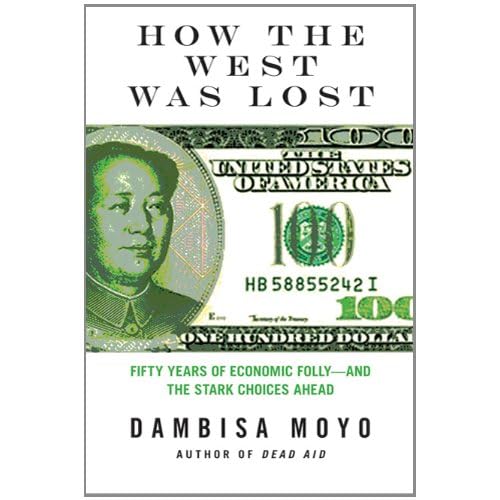
After her bestseller "Dead Aid", Zambian author Dambisa Moyo has presented her second book, "How the West was Lost: Fifty Years of Economic Folly--and the Stark Choices Ahead".
While "Dead Aid" was entirely focused on development in Africa, Moyo now turns to the industrialized West and diagnoses it with 50 years of paralysis.
Working along the terms capital, labor and productivity, Moyo says that the West and in particular the US (but also the UK) have failed in all three regards.
  • With regard to capital, the US went deeply into debt by borrowing from China and investing into housing.
  • As far as labor is concerned, Moyo holds that Western pensions, health care and education are seriously underfunded, and disregarded in the democratic four-year cycles of most Western countries.
  • Productivity gains in the West, finally, have stayed far below those in China. Western countries do not try to use education to produce higher-quality products and services, but fail to reform their systems, meaning that they are headed to compete with China on the same playing field: labor cost.
Although not saying that democracy is harmful, Moyo points out that four-year election cycles reward Western politicians for short-term thinking. To get out of decline, she proposes to either reform political systems in favor of a more long-term view, or to build strong incentives that encourage innovation and education. Or both. Without innovation, she says, countries will engage in a struggle for a shrinking amount of resources which is necessarily a zero-sum game and will produce bitter struggles.

If you want to listen to the full speech that Moyo recently gave at the LSE, you can do so here:


Picture Source: Amazon

Sunday, January 9, 2011

China and the "laowai"


"You don't know anything about China!"


I've heard that sentence quite a few times in China. One of the first words you will memorize as a foreigner in China is laowai, or foreigner. The word strikes a dividing line between you and the society in which you live. Being a foreigner, by definition you don't know China’s "unique national conditions". You don't know the exceptionalism that arises from a proud, 3000-year-old society, humiliated during the Opium Wars of the 19th century, invaded by foreign powers during the World Wars and mutilated by a ruler who is still praised as the country's national hero. And people will hold your ingnorance against you in the same way as this LSE (!) student does it from minute 44:00.

The relationship between China and the laowai is a very strange matter. On the one hand, Chinese people are extremely interested in American movies, American clothes, Christmas, McDonald's and other parts of Western consumerism. When I walked through central Shanghai, people were staring at me in awe. School girls asked me for a photo. Public schools in China employ foreigners to teach English, from high school all the way down to kindergarten. Clearly, there is an interest to know more about "the West" and about those laowai.

On the other hand, there is a deep inferiority complex toward those laowai. "Lao" itself means "old" and is normally used with a person in a more senior position. By definition, all laowai are filthy rich (which is true in a sense, considering the low value of the yuan). And filthy rich means that they're socially superior. A Chinese person will have to work a lot more than a Westerner to achieve the same social standard.

Put together the fact that Western people in China are filthy rich and that they have no idea about Chinese exceptionalism (or even the language, as the language in many foreign enterprises is English), could there be a desire to strike back at the West? Pay back the humiliation once Chinese money and power really kick off? Harvard Professor Niall Ferguson heard an invisible "We are the masters now" from his interlocutors when he recently went to China. In the EU, Portugal, Greece and Spain are now financially dependent on China. Are we facing a danger of revenge?

As laowai, we should probably spend some afternoons studying Chinese history - so that nobody can tell us "You don't know anything about China!" anymore.

Update (23/02/2011): We could start here, here or here.

Wednesday, January 5, 2011

MountEUlympus back in action

I've come home from China and will start blogging again. It's pretty exciting to come back just now, with the EU busy about the Hungarian Media Law, the Hungarian presidency, democracy in Italy and saving the Euro. Taken as a whole, 2010 has certainly been one of the EU's most challenging years since 1957.

The new year is always the time for new plans and new beginnings, so I will try to do some new things as well. First of all I'm honored to join the bloggingportal.eu editors. Hope that I can do some good things as an editor. To that effect, you can also add me on Twitter now. Secondly, I will give a new focus to my blogging. Sure, I'm still writing about institutional affairs and current EU events. But I want to pursue a few topical issues as well.

The most important one is China. We don't know anything about this new world power. And the way it is, we are headed into a clash of cultures between "the West" and China. In my blogging, I will take up issues that China talks about and take up EU-China questions, trying to avoid the conventional bias of our media. The question is, how can "the West" and China be reconciled? How can the faultlines be mended? Where does assimilation take place, in China or in "the West"? Obviously, talking about "the West" will not be limited to the EU but essentially incorporate the US as well...

The second aspect is the global economy. This will be a learning-by-doing experience, as my knowledge about international trade flow and finance only stems from a bachelor's degree. Together with the global economy, I also want to explore questions of sustainable development in the world.

The final aspect is event journalism. I will move into the Brussels bubble in a bit and try to cover some European Councils, press conferences and what else seems of interest to me and to you. Depending on the opportunities I get, I'm also going to play with my video camera and try to interview some of the people that keep the wheels spinning in Brussels.

At any rate, this is an exciting time to recommence blogging. After the #EUCO tweet wall event, I expect that we'll have to negotiate how blogging and bloggers can be incorporated into EU policy-shaping in the future.

Glad to start this new year together with you. I'm looking forward to a lot of fruitful interaction and debates.


P.S. if you're too busy to check this website for updates, how about copying its RSS feed into your feed reader?

Friday, August 27, 2010

Taking a break

After one and a half years, this blog is taking a break. A new personal project leads me to China where I will be far away from European affairs and politics in general.
I will continue following European blogs where I can and hope to pick up writing again when I come back.

It's been a great time and I've enjoyed blogging very much. Keep up the good work fellow bloggers, and show them that a Europe of the citizens is possible after all.


Best wishes,
André

Wednesday, January 6, 2010

North Sea grid: A test case for European leadership

With the new power grid that nine European countries are planning to install in the North Sea, the EU can easily increase the share of renewable energy to 30% by 2020, Justin Wilkes, policy director of the European Wind Energy Association (EWEA), told Deutsche Welle. It can only be hoped that the EU will indeed raise its commitments and start to be a veritable leader in the development of stable renewable energy sources.

Unlike the Desertec projects in the MENA countries and in Southeast Asia, the project headed by the Commission can produce results within ten years. Its success or failure will be an important milestone for the other two projects. It will show whether the ambitious projects can work or not. The essential questions for success or failure in the North Sea are:
  • will the participating countries fully cooperate, invest their resources and clear out legal obstacles? Or will fearful national politicians maintain a backdoor? (in which case everybody loses according to the prisoners' dilemma)
  • will the participating enterprises and credit agencies make a long-term commitment that can endure setbacks?
  • will citizens be prepared to give attention and donations to the project so that it can become a space for personal investment and personal identification?
  • will the media continue to report about the issue, so that the climate change discussion can maintain the momentum it has at the moment?
If the European aspiration is to be the leader in renewable energy in the world, this project must not fail. Since Copenhagen, the international negotiations are even less of a common effort and even more of a national power game. The Chinese lion has woken and will claim a greater say in global politics. After the soft power approach has failed in Copenhagen, the EU can win back its influence through enormous, astonishing success in its own front yard. The North Sea grid will be a test case: Can European countries unite for the greater good, or will we have another lose-lose situation as in Copenhagen?


Cross-posted on Th!nk about it

Saturday, September 26, 2009

Chinese in Europe - a glimpse of the future

Trying to familiarize myself with my new home in Milan, I took a stroll around the city and finally ended up in the Chinese district in the north of the city center. Ever since I read that Milan supposedly has the second biggest Chinatown in Europe, I've been very excited to get there and to see what was going on in there. The Financial Times journalist James Kynge believes that China is slowly taking over Italian production of fashion, starting with the manufacture of clothes in China, and ending with outsourcing the design of Italian fashion.

When I got there, I could see that incredible Chinese activity firsthand. Chinese workers, putting huge boxes of clothes into fashion stores, waiting to sell them to the next customers. Chinese men biking across the main road with heavy boxes of clothes loaded onto their bike. Chinese housing agencies, selling and renting out buildings and apartments of the district. And everywhere you see small offices with the label "Import - Export". I couldn't help thinking that they there was an entire city district, working hard to import Chinese products into the European market, and working even harder to export European money back to China. Kynge holds that many Chinese workers came here illegally to work in small jobs and earn money for their families back in China, slowly shifting wealth from Europe to southern Asia. And I could see myself that those workers tirelessly unloading more boxes of clothes were very committed to their job, even on a Saturday evening at 5 p.m.

I'll start surveying that Chinese district a little and try to find out more about it, try to find out why Chinese people came to Europe and how they harmonize with Italians in Milan. I have an inkling that this Chinatown gives a first impression of what the world may look like - maybe not in 20 years, but probably in 50 years time.

I have to admit that I was also seduced by all the cheap stores at the end of my visit, and I went to do my share of shopping. By now, maybe my money will already be invested in import-export businesses in China, fashion production in Shenzhen or maybe in high school and university education for Chinese students.