On 8 September, the II Youth Convention on Volunteering kicks off. More than 1500 registered participants are expected in the European Parliament in Brussels and on the Esplanade in front of it from 8 to 11 September. Many more young people from Brussels and its surroundings will visit workshops, events, discussions and free concerts on the Parliament Esplanade from Thursday afternoon to Saturday evening.
For those based in Brussels, the Convention offers a great opportunity to find information about volunteering and volunteers' rights, to join workshops, events, discussions and free concerts and to meet young people from all over Europe.
Those outside of Brussels may be interested in following the live blog of the event. Over three days, a young blogger team (disclaimer: I am one of them) will follow events, discussions, workshops and concerts for online readers.
Hope to see you online or offline - at the II Youth Convention on Volunteering.
Wednesday, September 7, 2011


Saturday, August 6, 2011
48 hours of blogging action against East Africa food crisis
This blogpost is part of the 48 Hours of Action against the famine in the Horn of Africa. It currently has a value of five working hours and 40 EUR of donations. Please let me know via the contact form if it influenced you to donate; I will adapt the figures.
In the 1980s, towards the end of the Cold War, Somalia was heavily dependent on food aid. After the Soviet Union stopped supporting the dictator Siad Barre, the United States saw their chance. The US and other Western countries planned to make Somalia a hub to increase their influence into the Indian Ocean; in particular, they tried to buy influence through food aid.
In consequence, the "value of foreign aid to Somalia soared to $80 per person, equivalent to half the gross domestic product," Martin Meredith observes in his book The State of Africa. "Leading loyalists [of the ruling clans] made fortunes from food aid, appropriating it then selling it on the market. A World Bank study, published in 1988, estimated that the growth of food aid was fourteen times higher than the growth of food consumption. From being a country self-sufficient in food grains, Somalia became dependent on imported food, all to the advantage of the ruling elite."
Until today, it has been difficult for common people in Somalia to access healthy, nutritious food. The country remains ruled by various clans and torn apart by civil war. What is new in the current crisis is that climate change has aggravated the situation. It means that consumption behavior and mobility preferences in industrial states are now directly related to food insecurity in developing countries.
Our immediate humanitarian impulse should be to wire the equivalent of a night out in the pubs to the donor agency of your choice – please see the buttons – to provide food to the starving population of Somalia (plus Ethiopia, Kenya and Uganda). But in the long term we have to urgently stop climate change. This year will hopefully see commitments to significantly reduce emissions at the COP17 Conference in Durban. The EU and China are progressing in emission reductions (the EU rather cautiously, China at an impressive pace), while the US has relegated climate change mitigation to the back row.
Reduction of GHG emissions are not a luxury but a security question. With every additional day that companies and airlines are allowed to pollute the environment, we are more likely to see droughts, rising temperatures, freshwater scarcity, unpredictable rain and monsoon, a rising sea level and more. In his movie An Inconvenient Truth, Al Gore has mapped out the consequences of 100 million climate refugees. The EU is already overburdened with 25,000 migrants.
It is time that the highest polluters per capita (2008) such as Qatar, Trinidad & Tobago and the United Arab Emirates, but also the US, Canada, Australia and several EU countries, realize the urgent necessity of fighting climate change. Otherwise, climate refugees may come and occupy their farmlands.
Update 08/08/2011: See the Guardian's take here: Is climate change to blame for famine in the Horn of Africa?
This blogpost is part of the 48 Hours of Action against the famine in the Horn of Africa. It currently has a value of five working hours and 40 EUR of donations. Please let me know via the contact form if it influenced you to donate; I will adapt the figures.
In the 1980s, towards the end of the Cold War, Somalia was heavily dependent on food aid. After the Soviet Union stopped supporting the dictator Siad Barre, the United States saw their chance. The US and other Western countries planned to make Somalia a hub to increase their influence into the Indian Ocean; in particular, they tried to buy influence through food aid.
 |
| UK Secretary of State for Development, Andrew Mitchell, in Dadaab refugee camp in Kenya CC BY DFID |
Until today, it has been difficult for common people in Somalia to access healthy, nutritious food. The country remains ruled by various clans and torn apart by civil war. What is new in the current crisis is that climate change has aggravated the situation. It means that consumption behavior and mobility preferences in industrial states are now directly related to food insecurity in developing countries.
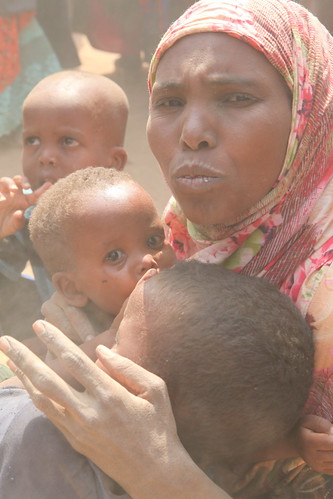 |
| A mother with her children in Dadaab refugee camp CC BY Oxfam |
Our immediate humanitarian impulse should be to wire the equivalent of a night out in the pubs to the donor agency of your choice – please see the buttons – to provide food to the starving population of Somalia (plus Ethiopia, Kenya and Uganda). But in the long term we have to urgently stop climate change. This year will hopefully see commitments to significantly reduce emissions at the COP17 Conference in Durban. The EU and China are progressing in emission reductions (the EU rather cautiously, China at an impressive pace), while the US has relegated climate change mitigation to the back row.
 |
| Farm animals in Somaliland died from undernutrition - CC BY-NC-ND Oxfam |
It is time that the highest polluters per capita (2008) such as Qatar, Trinidad & Tobago and the United Arab Emirates, but also the US, Canada, Australia and several EU countries, realize the urgent necessity of fighting climate change. Otherwise, climate refugees may come and occupy their farmlands.
Update 08/08/2011: See the Guardian's take here: Is climate change to blame for famine in the Horn of Africa?
This blogpost is part of the 48 Hours of Action against the famine in the Horn of Africa. It currently has a value of five working hours and 40 EUR of donations. Please let me know via the contact form if it influenced you to donate; I will adapt the figures.
Tuesday, July 26, 2011
Monitoring and web communications toolkit
Due to requests from some friends, in this post I put together a toolkit for monitoring EU affairs and communicating via the web. Using Google, Delicious, Twitter and some intelligent research commands can cut your research time in half.
Beside subscribing to newsletters, the first thing you could do is to use RSS feeds. Jon Worth's post over here tells you why. RSS feeds are common for most news websites; once you've subscribed, you receive the latest news automatically. To read them, though, you will need a feed reader. There are a few out there, such as the Google Reader; see Jon's post for details. Tell me more
Second, create Google Alerts. This little program will crawl the web and send you emails as soon as a new item with your search terms goes online. If you created a daily alert for 'EU agriculture', for example, you will comfortably receive your search results pertaining to EU agriculture in your inbox, structured in news results, blog results and web results. Tell me more
Third, to save time during your research, you can use intelligent search commands (for Alerts or regular searches). Among the more interesting ones are searches within a particular website. The search command Obama site:nytimes.com will show you every mention of Barack (or Michelle) Obama on the New York Times. You can also look for "Barack Obama" site:nytimes.com and will only find mentions of the President himself. Tell me more
Fourth, to keep track of all that you read online, you could use delicious.com, a tool that allows you to create bookmarks. You can access these bookmarks from any computer, allowing you to quickly find online articles that you read before.
With your monitoring tools thus set up, there are also many means to publish and publicize content. The easiest form to publish content is a blog, while the easiest way to spread it is via Twitter. The EU is now very active on Twitter; you can find a list of EU twitter contacts over at La Communication Européenne.
When you have produced content on your blog, programs like Twitterfeed, Hoot Suite or RSS Graffiti allow you to publish it to Facebook, LinkedIn and Twitter (could be very useful for those MEPs who stopped tweeting after the 2009 elections but who still maintain their websites). If you feel like it, create your own daily newspaper through paper.li. Google Analytics and other programs allow you to keep track of how many people visit your website. Be help of Feedburner, you can let readers subscribe to your website by email. Yahoo Pipes allows you to aggregate news feeds from several blogs or websites and even to translate them into other languages. I recently started using If this then that to combine different online tasks. I greatly love it, but it's still in beta phase and will evolve over time. To manage your Twitter account professionally and to quickly target new followers, you could use on of these programs, unfortunately none of them is free. Finally, to measure your online influence, have a look at klout.com.
While you're defining your target audience, don't forget to sign your website/blog up to several blog aggregators such as technorati.com or bloggingportal.eu. See more
In the end, however, getting readership is mainly about interaction. Reacting to blogposts and comments, retweeting other people's messages - this will draw a wider audience than if you only resort to automated publishing tools.
If you have other programs, blogpost links or ideas, please share them in the comments.
Beside subscribing to newsletters, the first thing you could do is to use RSS feeds. Jon Worth's post over here tells you why. RSS feeds are common for most news websites; once you've subscribed, you receive the latest news automatically. To read them, though, you will need a feed reader. There are a few out there, such as the Google Reader; see Jon's post for details. Tell me more
Second, create Google Alerts. This little program will crawl the web and send you emails as soon as a new item with your search terms goes online. If you created a daily alert for 'EU agriculture', for example, you will comfortably receive your search results pertaining to EU agriculture in your inbox, structured in news results, blog results and web results. Tell me more
Third, to save time during your research, you can use intelligent search commands (for Alerts or regular searches). Among the more interesting ones are searches within a particular website. The search command Obama site:nytimes.com will show you every mention of Barack (or Michelle) Obama on the New York Times. You can also look for "Barack Obama" site:nytimes.com and will only find mentions of the President himself. Tell me more
Fourth, to keep track of all that you read online, you could use delicious.com, a tool that allows you to create bookmarks. You can access these bookmarks from any computer, allowing you to quickly find online articles that you read before.
With your monitoring tools thus set up, there are also many means to publish and publicize content. The easiest form to publish content is a blog, while the easiest way to spread it is via Twitter. The EU is now very active on Twitter; you can find a list of EU twitter contacts over at La Communication Européenne.
When you have produced content on your blog, programs like Twitterfeed, Hoot Suite or RSS Graffiti allow you to publish it to Facebook, LinkedIn and Twitter (could be very useful for those MEPs who stopped tweeting after the 2009 elections but who still maintain their websites). If you feel like it, create your own daily newspaper through paper.li. Google Analytics and other programs allow you to keep track of how many people visit your website. Be help of Feedburner, you can let readers subscribe to your website by email. Yahoo Pipes allows you to aggregate news feeds from several blogs or websites and even to translate them into other languages. I recently started using If this then that to combine different online tasks. I greatly love it, but it's still in beta phase and will evolve over time. To manage your Twitter account professionally and to quickly target new followers, you could use on of these programs, unfortunately none of them is free. Finally, to measure your online influence, have a look at klout.com.
While you're defining your target audience, don't forget to sign your website/blog up to several blog aggregators such as technorati.com or bloggingportal.eu. See more
In the end, however, getting readership is mainly about interaction. Reacting to blogposts and comments, retweeting other people's messages - this will draw a wider audience than if you only resort to automated publishing tools.
If you have other programs, blogpost links or ideas, please share them in the comments.
Tuesday, July 19, 2011
How the EU quietly empties African waters
Making European fisheries more sustainable, stop overfishing and ban fish discards - those are the centerpieces of the new European fisheries policy. Fisheries Commissioner Maria Damanaki presented it to the media and the European Parliament last week; now it will go through the institutions and the European lobbies. While fisheries lobbies, NGOs and the European Parliament are starting to haggle about new fisheries quotas (set to be auctioned in much the same way as CO2 emission allowances are now), little attention goes to the fact that the EU currently subsidizes European fisheries in third-country waters with 65€ per ton.
The Commission regularly negotiates fisheries protocols with third countries, which are subsequently agreed between the EP's Fisheries and Development Committee (curtailed by the assent procedure, see Art. 218(6)(a) TFEU) and nodded off by the Council. In these protocols, lawmakers specify an upper limit of catches (e.g. 52000 tons per year in Seychelles). Up to this limit, the EU guarantees payment to the third country government, regardless of the number of total catches (fishermen add another 35€/ton). For every catch beyond the limit, the EU doubles its contribution to 130€/ton.
In effect, this not only encourages fishermen to rid the Seychelles of a full 52000 tons per year until 2014 (if they catch less, you and me provide free money to the Seychelles government), but also encourages the Seychelles government to neglect their fish stocks and to pocket a full 165€ for every ton exceeding the limit of 52000 tons/year. The agreement with São Tomé and Príncipe is based on the same terms, while new agreements with Cape Verde and Gabon are currently in the making. Overall, 15 agreements with developing countries are in force today. The consequences of the EU's policies are disastrous: No more fish by 2030.
In its new proposal, the Commission acknowledges that until now it had no information about other fisheries agreements concluded by the partner country, so that it was "often impossible to [...] determine the share of the surplus to be sustainably fished by the EU fleet". The new Common Fisheries Policy will subject EU vessels in foreign waters to the quota trading system, but the current agreements are valid until 2014 and the CFP reform is expected to take a few years until it is adopted. Therefore, in the short term, the EU will continue exploiting foreign waters and depleting African countries of the fish stocks.
3 July was the day of the year on which we started eating non-EU fish. If we want to save fish stocks in Africa, we should get selective about the fish we eat.
Update 16/09/2011: In a video interview, influential Development MEP Charles Goerens from Luxembourg told me that the fisheries agreements between the EU and African countries should in effect be phased out.
The Commission regularly negotiates fisheries protocols with third countries, which are subsequently agreed between the EP's Fisheries and Development Committee (curtailed by the assent procedure, see Art. 218(6)(a) TFEU) and nodded off by the Council. In these protocols, lawmakers specify an upper limit of catches (e.g. 52000 tons per year in Seychelles). Up to this limit, the EU guarantees payment to the third country government, regardless of the number of total catches (fishermen add another 35€/ton). For every catch beyond the limit, the EU doubles its contribution to 130€/ton.
In effect, this not only encourages fishermen to rid the Seychelles of a full 52000 tons per year until 2014 (if they catch less, you and me provide free money to the Seychelles government), but also encourages the Seychelles government to neglect their fish stocks and to pocket a full 165€ for every ton exceeding the limit of 52000 tons/year. The agreement with São Tomé and Príncipe is based on the same terms, while new agreements with Cape Verde and Gabon are currently in the making. Overall, 15 agreements with developing countries are in force today. The consequences of the EU's policies are disastrous: No more fish by 2030.
In its new proposal, the Commission acknowledges that until now it had no information about other fisheries agreements concluded by the partner country, so that it was "often impossible to [...] determine the share of the surplus to be sustainably fished by the EU fleet". The new Common Fisheries Policy will subject EU vessels in foreign waters to the quota trading system, but the current agreements are valid until 2014 and the CFP reform is expected to take a few years until it is adopted. Therefore, in the short term, the EU will continue exploiting foreign waters and depleting African countries of the fish stocks.
3 July was the day of the year on which we started eating non-EU fish. If we want to save fish stocks in Africa, we should get selective about the fish we eat.
Update 16/09/2011: In a video interview, influential Development MEP Charles Goerens from Luxembourg told me that the fisheries agreements between the EU and African countries should in effect be phased out.
Monday, July 18, 2011
MEPs should have the democratic right to decide where they meet
For those who haven't had a chance to read it over at PlaceLux.EU, here is the open letter that MEPs have sent to the new French secretary of State, Jean Leonetti (taken from MEP Raül Romeva i Rueda's blog).
CM. Jean Leonetti
Secrétaire d'Etat aux affaires européennes
Ministère des Affaires étrangères et européennes
37, Quai d'Orsay
75351 Paris
France
Secrétaire d'Etat aux affaires européennes
Ministère des Affaires étrangères et européennes
37, Quai d'Orsay
75351 Paris
France
Brussels, 14 July 2011
Dear Secretary of State,
MEPs should have the democratic right to decide where they meet
Please accept our congratulations on your appointment as France's new Minister for Europe. We wish you success.
There is now an Absolute Majority in the European Parliament in favour of a Single Seat. Following the vote on June 8 on the Multiannual Financial Framework, enough MEPs have now adjusted their record to achieve an absolute majority (373-285) on the paragraph pointing to "the significant savings that could be made if the European Parliament were to have a Single Seat". This Absolute Majority -as well as the 2012/2013 calendar vote in March- fundamentally shifts the debate.
As you know, the EU Treaty requires the European Parliament to hold 12 monthly plenary sessions in Strasbourg. As a result, we meet in Strasbourg 48 days every year. From next year, this will be 45 days, following our vote to hold the two October plenary sessions during the same week to save money, time and the environment. This democratic decision of the Parliament is being contested by France before the European Court of Justice in closed proceedings.
All of the Parliament's other activities take place in Brussels (with the exception of a part of the administration, which is based in Luxembourg). Brussels is where committee and political group meetings are held. It is where most of our staff are based. It is where the other two institutions that form the EU decision-making triangle (the Council and the Commission) are located. Over the last 50 years, Brussels has evolved into the EU's democratic capital. It is where companies, NGOs, national, regional and local governments, industry associations and trade unions all have their offices. It is where the EU press corps has its hub, including technical facilities.
When the European Parliament started meeting in Strasbourg over 50 years ago, it was a consultative assembly with part-time Members who were not directly elected, it was purely advisory and had no powers. Today, it is on a par with the Council of Ministers when it comes to making laws and its Members are full-time legislators, directly elected by the peoples of Europe. Yet unlike national parliaments, it cannot decide when and where it wishes to meet.
Recent votes in the European Parliament as well as several surveys have shown that a majority of MEPs believe the European Parliament should have a Single Seat, in Brussels. The Dutch and UK governments have publicly backed this view. More than 1,25 million European citizens have signed an online petition to this effect.
Over time a number of parliaments have moved to reflect political reality: the US Congress moved from Philadelphia to Washington; the French Parliament moved from Versailles to Paris; and more recently, the German Parliament moved from Bonn to Berlin. We believe that in a modern Europe, the European Parliament must be able to do the same. We call on the French government to stop the political and legal posturing on this issue, and to enter into a real debate.
All we ask is that MEPs should be able to exercise their democratic rights and decide when and where to meet. In return, we are ready to help identify alternatives for the city of Strasbourg, both in institutional and in economic terms.
For Strasbourg, a better and brighter future lies ahead. The European Parliament has now far outgrown it. It would be better to find an alternative that matches its facilities and can be a more grateful guest.
Yours sincerely,
(MEPs)
MEPs should have the democratic right to decide where they meet
Please accept our congratulations on your appointment as France's new Minister for Europe. We wish you success.
There is now an Absolute Majority in the European Parliament in favour of a Single Seat. Following the vote on June 8 on the Multiannual Financial Framework, enough MEPs have now adjusted their record to achieve an absolute majority (373-285) on the paragraph pointing to "the significant savings that could be made if the European Parliament were to have a Single Seat". This Absolute Majority -as well as the 2012/2013 calendar vote in March- fundamentally shifts the debate.
As you know, the EU Treaty requires the European Parliament to hold 12 monthly plenary sessions in Strasbourg. As a result, we meet in Strasbourg 48 days every year. From next year, this will be 45 days, following our vote to hold the two October plenary sessions during the same week to save money, time and the environment. This democratic decision of the Parliament is being contested by France before the European Court of Justice in closed proceedings.
All of the Parliament's other activities take place in Brussels (with the exception of a part of the administration, which is based in Luxembourg). Brussels is where committee and political group meetings are held. It is where most of our staff are based. It is where the other two institutions that form the EU decision-making triangle (the Council and the Commission) are located. Over the last 50 years, Brussels has evolved into the EU's democratic capital. It is where companies, NGOs, national, regional and local governments, industry associations and trade unions all have their offices. It is where the EU press corps has its hub, including technical facilities.
When the European Parliament started meeting in Strasbourg over 50 years ago, it was a consultative assembly with part-time Members who were not directly elected, it was purely advisory and had no powers. Today, it is on a par with the Council of Ministers when it comes to making laws and its Members are full-time legislators, directly elected by the peoples of Europe. Yet unlike national parliaments, it cannot decide when and where it wishes to meet.
Recent votes in the European Parliament as well as several surveys have shown that a majority of MEPs believe the European Parliament should have a Single Seat, in Brussels. The Dutch and UK governments have publicly backed this view. More than 1,25 million European citizens have signed an online petition to this effect.
Over time a number of parliaments have moved to reflect political reality: the US Congress moved from Philadelphia to Washington; the French Parliament moved from Versailles to Paris; and more recently, the German Parliament moved from Bonn to Berlin. We believe that in a modern Europe, the European Parliament must be able to do the same. We call on the French government to stop the political and legal posturing on this issue, and to enter into a real debate.
All we ask is that MEPs should be able to exercise their democratic rights and decide when and where to meet. In return, we are ready to help identify alternatives for the city of Strasbourg, both in institutional and in economic terms.
For Strasbourg, a better and brighter future lies ahead. The European Parliament has now far outgrown it. It would be better to find an alternative that matches its facilities and can be a more grateful guest.
Yours sincerely,
(MEPs)
Friday, July 8, 2011
Respect. Responsibility. Representation.
 |
| CC BY-NC heraldpost |
 |
| CC BY badkleinkirchheim |
 |
| CC BY ME-Arbeitgeber |
 |
| CC BY-NC-SA dolarz |
 |
| CC BY-NC hockeyshooter |
 |
| CC BY-NC-ND European Parliament |
Tuesday, July 5, 2011
MEP Robert Goebbels: We don't move if others don't move
Center-right MEPs today tore apart a report by Green MEP Bas Eickhout that would have asked the Commission to establish a 30% GHG emission reduction by 2020. The Greens ended up voting against their own report. Gulf Stream Blues has an interesting take on the vote and I have written about the 30% target last year.
I came across this post by Robert Goebbels, Luxembourgish S&D MEP, who proudly notes that he voted against the Eickhout report. I would have liked to comment on his blog but the captcha didn't let me. So here is my answer to his idea that the EU shouldn't move on GHG emissions before other global actors don't move.
As a side remark, you may note that China is actually quite progressive (update: extremely progressive) in its sustainable development policies. The US remain the prime polluter in the world, failing to adopt an emission trading scheme in 2010 and now attacking the EU's emission trading scheme.
Update (23/07/2011): Over at La Treizième Etoile, Andrew J. Burgess shows what happens to citizens who demand ambitious climate commitments from the EP.
I came across this post by Robert Goebbels, Luxembourgish S&D MEP, who proudly notes that he voted against the Eickhout report. I would have liked to comment on his blog but the captcha didn't let me. So here is my answer to his idea that the EU shouldn't move on GHG emissions before other global actors don't move.
Monsieur,
votre position montre le fait que vous êtes prêt a envoyer les générations suivantes vers un monde rechauffé.
Jouer des jeux de pouvoir avec la Chine et les Etats Unis dans le développement durable, cela n'a pas de sens. Une fois la planète rechauffée, il ne sert plus à rien d'avancer vers les 30%. Pour arrêter le changement climatique, il faut agir maintenant.
Sir,
your position shows that you are ready to send future generations into a warmer planet.
Playing power games with China and the United States doesn't make any sense in sustainable development. Once the planet is heated up, it won't help any more to fix a 30% target. To stop climate change, action is needed right now.
As a side remark, you may note that China is actually quite progressive (update: extremely progressive) in its sustainable development policies. The US remain the prime polluter in the world, failing to adopt an emission trading scheme in 2010 and now attacking the EU's emission trading scheme.
Update (23/07/2011): Over at La Treizième Etoile, Andrew J. Burgess shows what happens to citizens who demand ambitious climate commitments from the EP.
Subscribe to:
Posts (Atom)