With his poem "What must be said", to be found here [DE], German nobel prize laureat Günter Grass stirred up a heated discussion in Germany. At the core of it: Can Germany, the country that bears responsibility for the Holocaust, criticize Israel?
Public opinion in Germany seems to answer this question with a yes. Although I cannot find the figures, the majority of Germans looks at Israel's aggressive foreign policy with unease (and shows empathy with Palestinian citizens in the West Bank and the Gaza strip). When Günter Grass now writes that the "atomic power Israel endangers a world peace that is already crumbling" and criticizes the German shipment of a nuclear submarine to Israel, he speaks out what many German citizens have thought for a long time.
In other countries, this would not be a problem. But in Germany, where chancellor Merkel has declared Israel's security a piece of Germany's raison d'état and where a recent study has found "a banalization of antisemitist practices and rants that reaches far into the middle of the society", such a piece of criticism cannot be uttered without being called an antisemitist. German criticism of the state of Israel and of its government is always understood as criticism of the Israeli electorate, the Jewish nation.
And yet, the state of Israel is evidently in breach of several UN resolutions that deal with Israeli settlements in the West Bank and has repeatedly expressed its desire for a preemptive strike on Iran which would defy the intentions of the UN Charter. You could conveniently argue that every world citizen with an interest in peace should have the right to criticize Israel for its policy, regardless of their nationality.
What Günter Grass therefore advocates in his capacity as a global citizen is to put both the Iranian and the Israeli nuclear programs under the scrutiny of an international authority. If you look at the situation without a Western bias, the question is justified: Why subject the Irani nuclear program to external control and make an exception for Israel, although its attack could endanger Iranian citizens just as much as an Iranian attack would endanger Israelis?
As a German or non-German, what do you think of the question?
Showing posts with label United Nations. Show all posts
Showing posts with label United Nations. Show all posts
Saturday, April 7, 2012


Saturday, August 6, 2011
48 hours of blogging action against East Africa food crisis
This blogpost is part of the 48 Hours of Action against the famine in the Horn of Africa. It currently has a value of five working hours and 40 EUR of donations. Please let me know via the contact form if it influenced you to donate; I will adapt the figures.
In the 1980s, towards the end of the Cold War, Somalia was heavily dependent on food aid. After the Soviet Union stopped supporting the dictator Siad Barre, the United States saw their chance. The US and other Western countries planned to make Somalia a hub to increase their influence into the Indian Ocean; in particular, they tried to buy influence through food aid.
In consequence, the "value of foreign aid to Somalia soared to $80 per person, equivalent to half the gross domestic product," Martin Meredith observes in his book The State of Africa. "Leading loyalists [of the ruling clans] made fortunes from food aid, appropriating it then selling it on the market. A World Bank study, published in 1988, estimated that the growth of food aid was fourteen times higher than the growth of food consumption. From being a country self-sufficient in food grains, Somalia became dependent on imported food, all to the advantage of the ruling elite."
Until today, it has been difficult for common people in Somalia to access healthy, nutritious food. The country remains ruled by various clans and torn apart by civil war. What is new in the current crisis is that climate change has aggravated the situation. It means that consumption behavior and mobility preferences in industrial states are now directly related to food insecurity in developing countries.
Our immediate humanitarian impulse should be to wire the equivalent of a night out in the pubs to the donor agency of your choice – please see the buttons – to provide food to the starving population of Somalia (plus Ethiopia, Kenya and Uganda). But in the long term we have to urgently stop climate change. This year will hopefully see commitments to significantly reduce emissions at the COP17 Conference in Durban. The EU and China are progressing in emission reductions (the EU rather cautiously, China at an impressive pace), while the US has relegated climate change mitigation to the back row.
Reduction of GHG emissions are not a luxury but a security question. With every additional day that companies and airlines are allowed to pollute the environment, we are more likely to see droughts, rising temperatures, freshwater scarcity, unpredictable rain and monsoon, a rising sea level and more. In his movie An Inconvenient Truth, Al Gore has mapped out the consequences of 100 million climate refugees. The EU is already overburdened with 25,000 migrants.
It is time that the highest polluters per capita (2008) such as Qatar, Trinidad & Tobago and the United Arab Emirates, but also the US, Canada, Australia and several EU countries, realize the urgent necessity of fighting climate change. Otherwise, climate refugees may come and occupy their farmlands.
Update 08/08/2011: See the Guardian's take here: Is climate change to blame for famine in the Horn of Africa?
This blogpost is part of the 48 Hours of Action against the famine in the Horn of Africa. It currently has a value of five working hours and 40 EUR of donations. Please let me know via the contact form if it influenced you to donate; I will adapt the figures.
In the 1980s, towards the end of the Cold War, Somalia was heavily dependent on food aid. After the Soviet Union stopped supporting the dictator Siad Barre, the United States saw their chance. The US and other Western countries planned to make Somalia a hub to increase their influence into the Indian Ocean; in particular, they tried to buy influence through food aid.
 |
| UK Secretary of State for Development, Andrew Mitchell, in Dadaab refugee camp in Kenya CC BY DFID |
Until today, it has been difficult for common people in Somalia to access healthy, nutritious food. The country remains ruled by various clans and torn apart by civil war. What is new in the current crisis is that climate change has aggravated the situation. It means that consumption behavior and mobility preferences in industrial states are now directly related to food insecurity in developing countries.
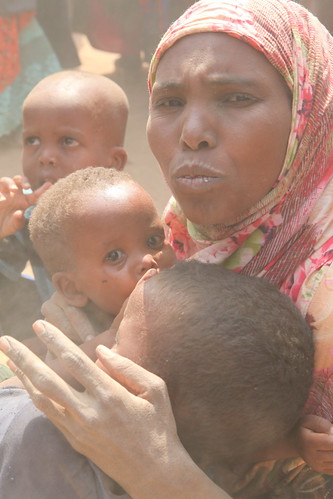 |
| A mother with her children in Dadaab refugee camp CC BY Oxfam |
Our immediate humanitarian impulse should be to wire the equivalent of a night out in the pubs to the donor agency of your choice – please see the buttons – to provide food to the starving population of Somalia (plus Ethiopia, Kenya and Uganda). But in the long term we have to urgently stop climate change. This year will hopefully see commitments to significantly reduce emissions at the COP17 Conference in Durban. The EU and China are progressing in emission reductions (the EU rather cautiously, China at an impressive pace), while the US has relegated climate change mitigation to the back row.
 |
| Farm animals in Somaliland died from undernutrition - CC BY-NC-ND Oxfam |
It is time that the highest polluters per capita (2008) such as Qatar, Trinidad & Tobago and the United Arab Emirates, but also the US, Canada, Australia and several EU countries, realize the urgent necessity of fighting climate change. Otherwise, climate refugees may come and occupy their farmlands.
Update 08/08/2011: See the Guardian's take here: Is climate change to blame for famine in the Horn of Africa?
This blogpost is part of the 48 Hours of Action against the famine in the Horn of Africa. It currently has a value of five working hours and 40 EUR of donations. Please let me know via the contact form if it influenced you to donate; I will adapt the figures.
Subscribe to:
Posts (Atom)