Fed up with widespread political apathy of the young generation, the editors of the European blog Europe & Me dared a bet: If they could mobilize 10,000 young Europeans to fill out a 4-minute survey on European Foreign Policy, its results will be presented at the Berlin Forum on Foreign Policy organized by the German foreign ministry, and discussed with European foreign ministers.
The survey not only asks young people to state their perception of current EU Foreign Policy ("who do you perceive to be the most prominent actor?", "is EU foreign policy easy to follow?") but also asks what young people perceive to be the most important challenges for the EU in the future.
At the time of writing this blogpost, there are just about seven days left to complete the survey. Might I invite you to give your opinion as well?
Some young Europeans, by the way, are not idle and politically apathetic at all: The European Youth Forum, together with MEP Emilie Turunen, the Young European Federalists (JEF) and other partners, are drafting a Quality charter for internships at the request of the European Parliament. Once this charter is established, every intern will be able to hold up a document to his future employer and demand his rights as they are written down.
Thursday, October 27, 2011


Sunday, October 23, 2011
EPP heads of govt retreat to Belgian castle to discuss European Council
It’s a busy weekend in Brussels. Yesterday’s Economic and Financial Affairs Council cleared the path for today’s European Council/Eurozone Summit, while the General Affairs yesterday discussed (PDF) economic policy and finalized the EU positions for the G20 summit in Cannes in November and the COP17 climate conference in Durban in December.
Somewhere in between, 13 heads of state and government belonging to the European People’s Party (EPP), reinforced by José Manuel Barroso, Herman van Rompuy and Jerzy Buzek, took a retreat to a beautiful castle outside of Brussels to save the Euro over a decent dinner.
Journalists were waiting in front of the castle nervously as the first shaded limousines pulled into the driveway. One by one, heads of state and government got out of their cars and walked past the journalists to the castle entrance. Angela Merkel, Finland’s Prime Minister Jyrki Katainen and Austria’s Foreign Minister Michael Spindelegger stopped to explain their expectancy of the summit, while Silvio Berlusconi put on a grin and ignored the journalists as his bodyguards walked him to the door. MEP Elmar Brok opened his passenger door alone and walked up to the castle by himself. By the time of his arrival, the journalists’ interest had waned and they were comparing their notes of the Merkel interview.
Your blogger had access to the advisors’ chamber, so over dinner I plugged into some interesting conversations. The advisors themselves were not fully aware of what was going on behind the closed doors of the meeting room, either. “Sometimes, very important progress is made in between the negotiations, in bilateral conversations in the hallway,” said German government spokesman Steffen Seibert. And after heads of government have negotiated a compromise among themselves, each of them returns home to win the approval of their Parliaments. “For those governments with a narrow majority, that can be quite a struggle,” Seibert said. Indeed, one reason for the postponement of the European Council to Wednesday is that Angela Merkel has not secured the approval of the German budget committee yet.
Throughout the dinner, buzz was high about the tête-à-tête between Sarkozy and Merkel after the EPP summit. Sarkozy did not participate in the summit but was due to arrive in Brussels later in the evening. According to media reports, however, the meeting only achieved little progress.
It seems that a lot of work remains as heads of government meet for the European Council today. And if the leaked conclusions prove to be true, there will not be an agreement on the recapitalization of the banks today.
 | |
| Angela Merkel's badge is waiting for her Source Flickr CC BY-NC-SA mounteulympus |
Journalists were waiting in front of the castle nervously as the first shaded limousines pulled into the driveway. One by one, heads of state and government got out of their cars and walked past the journalists to the castle entrance. Angela Merkel, Finland’s Prime Minister Jyrki Katainen and Austria’s Foreign Minister Michael Spindelegger stopped to explain their expectancy of the summit, while Silvio Berlusconi put on a grin and ignored the journalists as his bodyguards walked him to the door. MEP Elmar Brok opened his passenger door alone and walked up to the castle by himself. By the time of his arrival, the journalists’ interest had waned and they were comparing their notes of the Merkel interview.
Your blogger had access to the advisors’ chamber, so over dinner I plugged into some interesting conversations. The advisors themselves were not fully aware of what was going on behind the closed doors of the meeting room, either. “Sometimes, very important progress is made in between the negotiations, in bilateral conversations in the hallway,” said German government spokesman Steffen Seibert. And after heads of government have negotiated a compromise among themselves, each of them returns home to win the approval of their Parliaments. “For those governments with a narrow majority, that can be quite a struggle,” Seibert said. Indeed, one reason for the postponement of the European Council to Wednesday is that Angela Merkel has not secured the approval of the German budget committee yet.
Throughout the dinner, buzz was high about the tête-à-tête between Sarkozy and Merkel after the EPP summit. Sarkozy did not participate in the summit but was due to arrive in Brussels later in the evening. According to media reports, however, the meeting only achieved little progress.
It seems that a lot of work remains as heads of government meet for the European Council today. And if the leaked conclusions prove to be true, there will not be an agreement on the recapitalization of the banks today.
Friday, October 21, 2011
MountEUlympus at the EPP Summit
In the footsteps of Julien Frisch, Joe Litobarski and Andrew Burgess, your humble blogger will cover the summit of the European People's Party (EPP), held this Saturday evening in preparation for the European Council on Sunday (and Wednesday).
The EPP currently brings together 17 of the 27 European heads of state or government, among others Angela Merkel, Nicolas Sarkozy, Donald Tusk and Silvio Berlusconi. Discussions at the summit will mainly center around the Eurocrisis, which already brought one EPP government down last week (Iveta Radicová's liberal-conservative coalition in Slovakia). Will EU leaders, Merkel and Sarkozy most of all, be able to come to a sustainable agreement? Will they be able to produce a consistent solution that appeases the markets and brings back politicians' credibility? These are the questions that this blog will address at the EPP summit.
I will be live-tweeting directly from the summit (follow my account @mounteulympus or the hashtags #epp and #euco) and provide you with a round-up in the aftermath of the summit on this blog. You can send me your questions, comments and remarks by comment function, via Twitter or through the contact form, and I will try to address them at the summit.
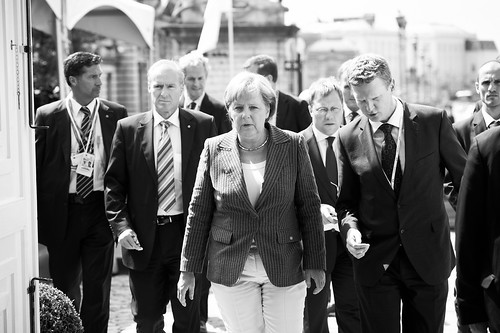 | |
| Angela Merkel at the EPP Summit in June 2011 Source: Flickr CC BY europeanpeoplesparty |
I will be live-tweeting directly from the summit (follow my account @mounteulympus or the hashtags #epp and #euco) and provide you with a round-up in the aftermath of the summit on this blog. You can send me your questions, comments and remarks by comment function, via Twitter or through the contact form, and I will try to address them at the summit.
Saturday, October 8, 2011
Macroeconomic convergence in the EU - ok, but what about structural funds?
The macroeconomic stability regulations that the European Parliament passed in late September, better known as "sixpack", lay down severe penalties for countries whose economies exceed the European average by too much. This could hit overachieving Germany just as much as underperforming Greece.
Two of the six pieces of legislation are relevant for this, the Ferreira regulation and the Haglund regulation. The Ferreira regulation allows for the establishment of "an alert mechanism for early detection of emerging macroeconomic imbalances" within the European Commission, but under consultation of the European Systemic Risk Board. This mechanism "should be based on use of an indicative and transparent scoreboard comprising indicative thresholds, combined with economic judgment" (see the exact rules for the scoreboard in the regulation).
The aim of the two regulations is among others to bring the macroeconomic policies of the 17 different Eurozone economies closer together. While one country lowers taxes, establishes a minimum wage and gives out subsidies to make people spend more, it should be safeguarded that its neighbor doesn't raise taxes to keep its purchasing power at home (Germany has been pretty good at that over the last decade, and France was rather angry about it).
While the structural funds of the EU (European Regional Development Fund, European Social Fund, Cohesion Fund and two others) are not directly related to macroeconomic policy of the member state governments, they also have an important role in bringing European economies closer together. The Commission has just published its proposal for the structural funds 2014-20, which are expected to have a volume of 336 billion EUR. Three different types of regions are to profit from the funds, namely
Update (10/10/11): The Commission's 6 October proposal does incorporate a suspension of cohesion funds if macroeconomic criteria are not met. Read more here.
Two of the six pieces of legislation are relevant for this, the Ferreira regulation and the Haglund regulation. The Ferreira regulation allows for the establishment of "an alert mechanism for early detection of emerging macroeconomic imbalances" within the European Commission, but under consultation of the European Systemic Risk Board. This mechanism "should be based on use of an indicative and transparent scoreboard comprising indicative thresholds, combined with economic judgment" (see the exact rules for the scoreboard in the regulation).
The aim of the two regulations is among others to bring the macroeconomic policies of the 17 different Eurozone economies closer together. While one country lowers taxes, establishes a minimum wage and gives out subsidies to make people spend more, it should be safeguarded that its neighbor doesn't raise taxes to keep its purchasing power at home (Germany has been pretty good at that over the last decade, and France was rather angry about it).
While the structural funds of the EU (European Regional Development Fund, European Social Fund, Cohesion Fund and two others) are not directly related to macroeconomic policy of the member state governments, they also have an important role in bringing European economies closer together. The Commission has just published its proposal for the structural funds 2014-20, which are expected to have a volume of 336 billion EUR. Three different types of regions are to profit from the funds, namely
- less developed regions, whose GDP is below 75% of the Union average (this will continue to be the top priority for the policy)
- transition regions, whose GDP is between 75% and 90% of the EU 27 average
- more developed regions, whose GDP per capita is above 90% of the average.
|
|
|---|

Update (10/10/11): The Commission's 6 October proposal does incorporate a suspension of cohesion funds if macroeconomic criteria are not met. Read more here.
Sunday, October 2, 2011
Finally - a debate about the future of the European Union in Germany
For one and a half years, debates on the European Union in Germany could be largely summed up as "we always pay, we never get anything back". Not only is this wrong, the pure limitation to financial aspects also obstructed the view upon a more important question: In a world where the European Union "will account for only 18% of world GDP in 2020, signifying a decline of 28%" compared with 2000 levels, are citizens prepared to give the EU strong multilateral institutions? This question has long been left unanswered in Germany. The Lisbon treaty was nodded off without debate.
Thanks to finance minister Schäuble, the debate now seems to take a new turn. Schäuble has always been one of the most fervent supporters of more European integration. After his initiatives for a European Monetary Fund (more or less granted), a European rating agency (still negotiated) and an economic government for the Eurozone (granted), the German finance minister yesterday pursued that the answer to the European debt crisis can only be more Europe. For once, I've got the feeling that the debate is not directed against fellow European countries but towards the degree of competence to be given to Brussels.
Chancellor Angela Merkel gave a one-hour televised live interview last week in which she explained the reasons behind the EFSF. This doesn't happen very often, and it may have given many people a new view upon the EU and Germany's role in. People begin to understand that the country profits a lot from European integration and stronger institutions do not necessarily mean less democracy.
The time is right to pursue this debate and to wonder what Europe will look like in the future. Bavaria's CSU, in dire need of voter support, warns against a "European superstate", but it was apparent from the EFSF vote last week that there is room for more Europe in large parts of CDU, Social Democrats and Greens.
Unnoticed by many, chief German constitutional lawyer Andreas Voßkuhle recently gave an interview in which he predicted (14min30) that Germany may pave the way for stronger European institutions (within the next 10-20 years, roundabout), and give itself a new constitution to accommodate these changes. The time hasn't come for such a quantum leap, but I've got the feeling politicians start laying out the cobble stones to get there.
I hope that there will be an honest debate about the future of the EU, not only in the Parliament but also in the public sphere. After Schäuble started the debate, the next few days will show if other parties are prepared to exchange some serious arguments on this.
Thanks to finance minister Schäuble, the debate now seems to take a new turn. Schäuble has always been one of the most fervent supporters of more European integration. After his initiatives for a European Monetary Fund (more or less granted), a European rating agency (still negotiated) and an economic government for the Eurozone (granted), the German finance minister yesterday pursued that the answer to the European debt crisis can only be more Europe. For once, I've got the feeling that the debate is not directed against fellow European countries but towards the degree of competence to be given to Brussels.
Chancellor Angela Merkel gave a one-hour televised live interview last week in which she explained the reasons behind the EFSF. This doesn't happen very often, and it may have given many people a new view upon the EU and Germany's role in. People begin to understand that the country profits a lot from European integration and stronger institutions do not necessarily mean less democracy.
The time is right to pursue this debate and to wonder what Europe will look like in the future. Bavaria's CSU, in dire need of voter support, warns against a "European superstate", but it was apparent from the EFSF vote last week that there is room for more Europe in large parts of CDU, Social Democrats and Greens.
Unnoticed by many, chief German constitutional lawyer Andreas Voßkuhle recently gave an interview in which he predicted (14min30) that Germany may pave the way for stronger European institutions (within the next 10-20 years, roundabout), and give itself a new constitution to accommodate these changes. The time hasn't come for such a quantum leap, but I've got the feeling politicians start laying out the cobble stones to get there.
I hope that there will be an honest debate about the future of the EU, not only in the Parliament but also in the public sphere. After Schäuble started the debate, the next few days will show if other parties are prepared to exchange some serious arguments on this.
Sunday, September 25, 2011
It's good to live in a shared European Union
 |
| Verdun, 24 September 2011 CC BY-NC-ND André Feldhof |
much better than to live in a Europe of hostile nation-states


Wednesday, September 21, 2011
75% of European interns are unpaid or insufficiently paid
A new survey by the European Youth Forum reveals that three out of four young Europeans are either unpaid or do not receive sufficient compensation to pay for their living expenses. Only about 25% of all respondents were able to pay all of their living expenses with their internship allowance. The European Youth Forum conducted a 4-month survey and obtained slightly over 3000 responses.
According to the survey, a large majority of employers did not give a particular reason of why they could not pay their interns, prompting 64,7% of the respondents to rely on funding from their parents. From the survey results, it becomes clear what employers are banking on. Taking out a loan of 4000 EUR for a 6-month unpaid internship deters those applicants whose parents cannot finance them. Employers thereby ensure that applicants will come from a wealthy background and preferably received a high degree of informal education via their personal environment.
From a recent Twitter exchange with the World Development Movement, a small development NGO based in the UK, I gathered two things:
WDM is only one of the examples for insufficient treatment of interns and for bleak inconsiderateness about the world's future qualified labor pool. There are many more.
In cooperation with MEP Emilie Turunen and other partners, the Youth Forum is elaborating a Quality Charter for Internships at the request of the European Parliament. It will be non-binding, but if there is a clear measuring rod, interns have a document to which they can point when they demand their rights in future.
According to the survey, a large majority of employers did not give a particular reason of why they could not pay their interns, prompting 64,7% of the respondents to rely on funding from their parents. From the survey results, it becomes clear what employers are banking on. Taking out a loan of 4000 EUR for a 6-month unpaid internship deters those applicants whose parents cannot finance them. Employers thereby ensure that applicants will come from a wealthy background and preferably received a high degree of informal education via their personal environment.
From a recent Twitter exchange with the World Development Movement, a small development NGO based in the UK, I gathered two things:
- WDM refuses to pay its interns despite +£139,217 in last year's accounts
- When I confronted them, they pointed to the small size of their organization and more importantly to the fact that "we only recruit internally, thus giving interns a much stronger chance of employment with WDM" and that "if we had to pay wages to interns, it would be unlikely that we could offer an internship programme".
WDM is only one of the examples for insufficient treatment of interns and for bleak inconsiderateness about the world's future qualified labor pool. There are many more.
In cooperation with MEP Emilie Turunen and other partners, the Youth Forum is elaborating a Quality Charter for Internships at the request of the European Parliament. It will be non-binding, but if there is a clear measuring rod, interns have a document to which they can point when they demand their rights in future.
Subscribe to:
Posts (Atom)